Tuesday, July 31, 2018

Top 5 Gold Stocks To Own Right Now

tags:ORE,CME,NGD,NXG,

Over the past few years, the e-sports industry expanded from small professional gaming events into televised and live-streamed programs�watched by millions. Goldman Sachs valued the e-sports market at $500 million in 2016, and expects the market to grow at a compound annual growth rate of 22% over the next three years to over $1 billion.

But amid all the hype and noise, investors might be confused about which companies will benefit the most from that growth. Let's examine three companies that fit that bill -- Tencent Holdings (NASDAQOTH:TCEHY), Activision Blizzard (NASDAQ:ATVI), and Electronic Arts (NASDAQ:EA).

Tencent Holdings

Chinese tech giant Tencent is the biggest video game company in the world by total revenue. Six years ago, it acquired Riot Games, the maker of League of Legends -- the MOBA (multiplayer online battle arena) game which is currently the most popular e-sports title in the world.

League of Legends. Image source: Riot Games, NVIDIA.

Top 5 Gold Stocks To Own Right Now: Orezone Gold Corp (ORE)

Advisors' Opinion:
  • [By Stephan Byrd]

    Galactrum (ORE) is a PoW/PoS coin that uses the
    Lyra2RE hashing algorithm. It launched on November 11th, 2017. Galactrum’s total supply is 2,092,679 coins and its circulating supply is 1,372,679 coins. Galactrum’s official Twitter account is @galactrum. Galactrum’s official website is galactrum.org.

  • [By Jim Robertson]

    Finally, Richard Seville, the CEO of Brisbane-based Orocobre Ltd (ASX: ORE) which began lithium sales in 2015 from northern Argentina and also experienced difficulty boosting output, commented that an ��inability to access traditional funds has delayed the development of the sector�� and that ��these projects aren��t easy -- so the banks just don��t want to go there.��

Top 5 Gold Stocks To Own Right Now: CME Group Inc.(CME)

Advisors' Opinion:
  • [By Ethan Ryder]

    CME Group (NASDAQ:CME) was downgraded by investment analysts at BidaskClub from a “strong-buy” rating to a “buy” rating in a research report issued on Thursday.

  • [By Logan Wallace]

    Get a free copy of the Zacks research report on CME Group (CME)

    For more information about research offerings from Zacks Investment Research, visit Zacks.com

  • [By ]

    Case in point, I've held CME Group (NYSE: CME) in my High-Yield Investing portfolio for almost four years now. When I first took a position in the summer of 2014, the stock offered a regular quarterly dividend of $0.47 per share that added up to a modest yield of 2.6%. Many income investors skipped over it without a second glance.

  • [By Ethan Ryder]

    Shares of CME Group Inc (NASDAQ:CME) have been given a consensus recommendation of “Buy” by the seventeen research firms that are covering the company, MarketBeat Ratings reports. Three research analysts have rated the stock with a hold recommendation and thirteen have given a buy recommendation to the company. The average 1 year target price among brokerages that have updated their coverage on the stock in the last year is $165.57.

Top 5 Gold Stocks To Own Right Now: NEW GOLD INC.(NGD)

Advisors' Opinion:
  • [By Paul Ausick]

    New Gold Inc. (NYSEAMERICAN: NGD) dropped about 2.9% Monday to post a new 52-week low of $2.35. Shares closed at $2.42 on Friday and the stock’s 52-week high is $4.25. Volume was about 10% below the daily average of around 5.8 million shares. The gold mining company had no news.

  • [By Paul Ausick]

    New Gold Inc. (NYSE: NGD) dropped about 4.7% Friday to post a new 52-week low of $2.05. Shares closed at $2.15 on Thursday and the stock’s 52-week high is $4.25. Volume was about 50% higher than the daily average of 4.2 million. The junior gold miner had no specific news.

  • [By Lisa Levin]

    Check out these big penny stock gainers and losers

    Losers Check-Cap Ltd. (NASDAQ: CHEK) fell 23.3 percent to $9.87 in pre-market trading after declining 13.45 percent on Wednesday. SunCoke Energy Partners, L.P. (NYSE: SXCP) fell 12.8 percent to $16.00 in pre-market trading after reporting Q1 results. Briggs & Stratton Corporation (NYSE: BGG) fell 11 percent to $17.55 in pre-market trading after the company posted mixed Q3 results and lowered its FY18 guidance. New Gold Inc. (NYSE: NGD) fell 8.4 percent to $2.30 in pre-market trading following downbeat Q1 results. Quality Care Properties, Inc. (NYSE: QCP) fell 8.2 percent to $20.85 in pre-market trading. Welltower announced plans to acquire QCP for $20.75 per share in cash. China Customer Relations Centers Inc. (NASDAQ: CCRC) shares fell 7.5 percent to $17.25 in pre-market trading after climbing 18.73 percent on Wednesday. Nokia Corporation (NYSE: NOK) shares fell 5.7 percent to $5.58 in pre-market trading after reporting Q1 results. eBay Inc. (NASDAQ: EBAY) fell 5.6 percent to $38.66 in pre-market trading following Q1 results. Southw
  • [By Paul Ausick]

    New Gold Inc. (NYSEAMERICAN: NGD) dropped about 1.9% Tuesday to post a new 52-week low of $2.09. Shares closed at $2.13 on Monday and the stock’s 52-week high is $4.25. The junior gold miner had no specific news.

Top 5 Gold Stocks To Own Right Now: Northgate Minerals Corporation(NXG)

Advisors' Opinion:
  • [By Shane Hupp]

    Shares of NEX Group PLC (LON:NXG) have been given an average rating of “Hold” by the nine ratings firms that are presently covering the company, Marketbeat.com reports. One research analyst has rated the stock with a sell recommendation, four have assigned a hold recommendation and four have assigned a buy recommendation to the company. The average 1 year price objective among analysts that have issued ratings on the stock in the last year is GBX 696 ($9.21).

Saturday, July 21, 2018

Obalon Therapeutics (OBLN) Reaches New 12-Month Low at $2.01

Obalon Therapeutics Inc (NASDAQ:OBLN) reached a new 52-week low on Monday . The stock traded as low as $2.01 and last traded at $2.01, with a volume of 57159 shares trading hands. The stock had previously closed at $2.20.

Several equities research analysts recently weighed in on the company. Zacks Investment Research lowered Obalon Therapeutics from a “hold” rating to a “sell” rating in a research report on Wednesday, July 11th. ValuEngine upgraded Obalon Therapeutics from a “hold” rating to a “buy” rating in a research report on Wednesday, July 4th. Stifel Nicolaus lowered Obalon Therapeutics from a “buy” rating to a “hold” rating in a research report on Friday, May 11th. Finally, Northland Securities lowered Obalon Therapeutics from a “market perform” rating to an “underperform” rating in a research report on Friday, May 11th. Two analysts have rated the stock with a sell rating, one has given a hold rating and four have assigned a buy rating to the company’s stock. The stock presently has an average rating of “Hold” and an average target price of $8.40.

Get Obalon Therapeutics alerts:

The company has a quick ratio of 4.09, a current ratio of 4.29 and a debt-to-equity ratio of 0.29. The stock has a market cap of $35.32 million, a price-to-earnings ratio of -0.97 and a beta of -2.58.

Obalon Therapeutics (NASDAQ:OBLN) last issued its quarterly earnings data on Thursday, May 10th. The company reported ($0.71) EPS for the quarter, missing analysts’ consensus estimates of ($0.54) by ($0.17). Obalon Therapeutics had a negative return on equity of 102.17% and a negative net margin of 399.94%. The company had revenue of $1.35 million for the quarter, compared to the consensus estimate of $3.55 million. equities analysts forecast that Obalon Therapeutics Inc will post -2.19 EPS for the current fiscal year.

A hedge fund recently bought a new stake in Obalon Therapeutics stock. Goldman Sachs Group Inc. acquired a new position in shares of Obalon Therapeutics Inc (NASDAQ:OBLN) during the fourth quarter, according to the company in its most recent Form 13F filing with the Securities and Exchange Commission. The institutional investor acquired 237,647 shares of the company’s stock, valued at approximately $1,571,000. Goldman Sachs Group Inc. owned about 1.04% of Obalon Therapeutics as of its most recent SEC filing. 35.93% of the stock is currently owned by institutional investors and hedge funds.

About Obalon Therapeutics

Obalon Therapeutics, Inc, a vertically integrated medical device company, focuses on developing and commercializing medical devices to treat obese and overweight people by facilitating weight loss. It offers the Obalon balloon system designed to provide weight loss in obese patients. Obalon Therapeutics, Inc was founded in 2008 and is headquartered in Carlsbad, California.

Read More: Short Selling Stocks and Day Traders

Monday, July 16, 2018

Trump ratchets up 'fake news' rally cry overseas during UK visit

Even when he's thousands of miles from home, President Trump defaults back to his "fake news" insult whenever it's convenient or politically expedient.

On Friday, he deployed the term against a surprise target -- a British newspaper owned by his ally Rupert Murdoch -- along with two US-based networks, CNN and NBC.

The White House Correspondents Association chastised the president in a statement later in the day.

"Saying a news organization isn't real doesn't change the facts and won't stop us from doing our jobs," the association said.

At a press conference on Friday, Trump dismissed The Sun newspaper as an example of "fake news," hours after giving an exclusive interview to the same paper for its Friday cover story.

In the 28-minute-long interview, Trump made comments critical of British prime minister Theresa May's Brexit plan. The shocking remarks dominated news coverage in the UK and the US as Trump began a day of meetings with May on Friday.

So reporters asked Trump about the jabs at a joint news conference with May. He accused The Sun of leaving out his positive comments about May.

"It's called fake news," he said.

"I didn't criticize the prime minister. I have a lot of respect for the prime minister," he added. "It didn't put in what I said about the prime minister and I said tremendous things."

The Sun had already published audio recordings of key parts of the interview.

Trump said his aides had their own recording of the interview and suggested the tape would prove him right. "Get it from Sarah," he said, referring to press secretary Sarah Sanders. So far, however, Sanders has not provided any tape.

The Sun pointed out that its story did, in fact, include Trump's positive remarks about May.

"We stand by our reporting and the quotes we used -- including those where the President was positive about the Prime Minister, in both the paper and in our audio -- and we're delighted that the President essentially retracted his original charge against the paper later in the press conference," the newspaper said in a statement.

"To say the President called us 'fake news' with any serious intent is, well... fake news," The Sun added.

Trump also derided two other news outlets, NBC and CNN, during the joint press conference.

He called on NBC's Kristen Welker, who asked, "Are you giving Russian president Vladimir Putin the upper hand heading into your talks, given that you are challenging these alliances that he seeks to break up and destroy?"

Trump: "See, that's such dishonest reporting," he said, lambasting both NBC and CNN, which he frequently lumps together.

Later, CNN's Jim Acosta tried to ask a question: "Mr. President, since you attacked CNN, can I ask you a question?"

"No, no," Trump responded, calling the network "fake news."

"I don't take questions from CNN," Trump said, even though he did take a question from CNN's Jeremy Diamond on Thursday.

Trump then called on Fox News correspondent John Roberts and called Fox "real news."

On social media, some journalists criticized Roberts -- a former CNN employee -- for not standing up for the network.

CNN's Jake Tapper tweeted that he is "old enough to remember when other networks came to the defense of Fox News WH correspondents during the Obama years. Such did not happen here. Lesson for the kids out there: no one should ever try to do the right thing with the expectation it will ever be reciprocated."

Margaret Talev, the president of the White House Correspondents Association, responded to the president's comments about NBC, CNN and The Sun this way:

"Asking smart, tough questions, whether in a presidential press conference or interview, is central to the role a free press plays in a healthy republic," she said. "Given that the president took a question from a CNN reporter in his NATO news conference just a day earlier, maybe he was letting off steam today rather than expressing an official stance toward a news organization's ability to report, but saying a news organization isn't real doesn't change the facts and won't stop us from doing our jobs. We appreciate The Sun for posting the entire audio of their interview so that everyone can hear the president's remarks for themselves."

Tuesday, July 10, 2018

How Carvana Co. Can Win for Investors Long Term

Superior customer experience with next-day delivery -- or innovative vehicle vending machine experience? Check. Proven go-to-market strategy? Check. Fine-tuned�website that enables consumers to purchase a vehicle within 10 minutes? Check. Carvana (NYSE:CVNA) checks a lot of boxes for investors looking for a young company that could flourish in the years ahead, but there's one very important step the company needs to take.

Special delivery

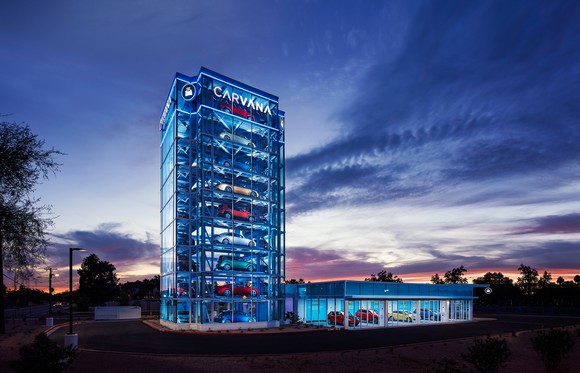
When considering what makes Carvana intriguing as a seller of used vehicles, the first thing that should grab investors' attention is its unique vending machine, which provides some differentiation and an element of fun compared to the traditional dealership experience. The company's most recently opened machine, its 12th, is in Tempe, Arizona, stands nine stories high, and holds up to 34 vehicles. Customers use an oversize coin to activate the vending process -- an experience worthy of sharing on social media, of course.

A nine-story glass building holding up to 34 cars.

Carvana's latest vending machine. Image source: Carvana Co.

For consumers who prefer a more traditional internet-based path to purchasing a vehicle, Carvana's website offers a quick and seamless experience with over 11,000 vehicle options, the ability for consumers to trade or sell their existing vehicle, and even personalized financing. Customers can schedule a delivery appointment as soon as the next day. It's a compelling way to purchase a used car and avoid the historical dealership experience.

What Carvana needs to do

Carvana's operations are innovative, but investors need more than that to buy in. And that's where Carvana must consistently show progress on gross profit per unit (GPU). We know Carvana is going to grow its top line as it enters into a slew of new�U.S. markets; in fact, Carvana's 44 markets at the end of the fourth quarter of 2017 are expected to explode to as many as 84 by the end of 2018. But it also needs to narrow the gap with its competitors on GPU. Let's use CarMax (NYSE:KMX), a competitor that logged an excellent 2018 first quarter,�as an example.�

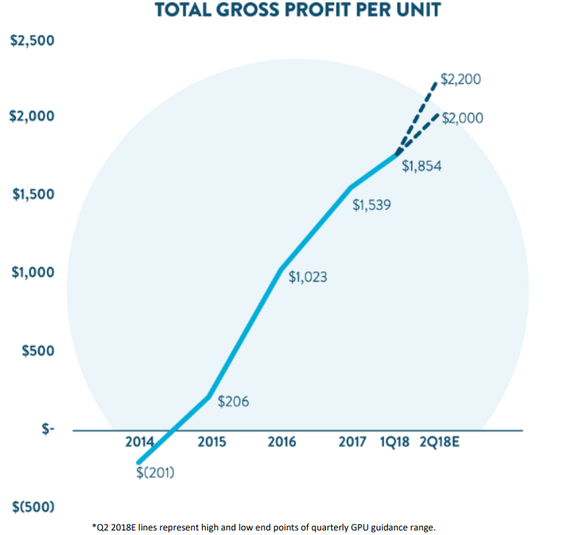
Carvana's retail used-car GPU checked in at $902 during the first quarter of 2018, a massive improvement from the prior year's $555, but a far cry from CarMax's $2,215 per unit. The story is much the same for both companies' wholesale vehicle GPU: Carvana's checked in at $73, another large improvement over the prior year's $19, but far below CarMax's $1,012. While Carvana has a long way to go to catch more established competitor CarMax in GPU, it has made substantial improvement since 2014.

Carvana's total GPU moving from a loss in 2014 to a projected $2,000 during 2018.

Image source: Carvana's May 9, 2018, letter to shareholders.

Carvana has made progress generating higher total GPU on the march toward its $3,000 medium-term�target, which narrows the gap between its Q1 2018 total GPU and CarMax's Q1 2018 total GPU of $3,333. To continue this, management needs to reduce average days to sale by increasing the number of markets it participates in, and the total sales, at a faster rate than it increases inventory. After management becomes satisfied with the rate of its market entry growth with levels of inventory, it then needs to grow into its inspection and reconditioning center capacity, and continue to increase inventory at a healthy rate. Carvana currently has four facilities with the collective capacity to inspect and recondition roughly 200,000 vehicles annually. For context, that's more than twice the 90,000 to 94,000 retail sales Carvana has forecast for 2018.�

Ultimately, if there's one metric investors need to keep an eye on, it's GPU. That's simply because we can expect, or at least certainly hope, that Carvana's top line will continue to post explosive growth as it aggressively expands into new markets. We can also expect expenses to rise as it does so, making profitability difficult in the near term. But for its long-term potential to reward shareholders, it must spend to enter new markets so it can grow into its capacity�and reach more consumers, while increasing inventory at a healthy rate to improve GPU at the same time -- that's how Carvana becomes a more lucrative business. And that's how investors will win in the long term.

Saturday, July 7, 2018

How To Talk Retirement With Your Spouse

&l;p&g;&l;img class=&q;dam-image shutterstock size-large wp-image-1125830159&q; src=&q;https://specials-images.forbesimg.com/dam/imageserve/1125830159/960x0.jpg?fit=scale&q; data-height=&q;640&q; data-width=&q;960&q;&g; Shutterstock

If you&a;rsquo;ve never talked about retirement with your spouse, you&a;rsquo;re not alone. But it&a;rsquo;s a crucial conversation if you want your retirement dreams to become reality.

Thirty-six percent of couples say they haven&a;rsquo;t even thought about a retirement plan, and 47% of couples disagree about how much money they&a;rsquo;ll need in retirement, according to a Fidelity Investments survey of 1,051 couples in 2015.

&a;ldquo;People are more comfortable talking about sex than money,&a;rdquo; says John Schwartz, author of &a;ldquo;This Is the Year I Put My Financial Life in Order&a;rdquo; and a reporter who covers climate change for The New York Times. &a;ldquo;It&a;rsquo;s so emotionally fraught that it&a;rsquo;s a topic a lot of people just avoid.&a;rdquo;

&l;strong&g;How to begin&l;/strong&g;

The million-dollar question that undergirds all other retirement questions is: Are your savings on track to support your desired future lifestyle? Working together to determine this, perhaps using a &l;a href=&q;https://www.nerdwallet.com/investing/retirement-calculator?utm_campaign=ct_prod&a;amp;utm_source=forbes&a;amp;utm_medium=mpsyn&q; target=&q;_blank&q;&g;retirement calculator&l;/a&g;, can help start the conversation.

Thinking about retirement can be tough for some people. They might associate it with getting old, or a relative&a;rsquo;s gloomy nursing home experience. If that&a;rsquo;s true for your spouse, plan your conversations carefully.

Don&a;rsquo;t bring up retirement when either of you is stressed or tired, says Syble Solomon, financial behavior specialist and creator of Money Habitudes, an online game for figuring out your attitude toward money.

&l;!--nextpage--&g;

Instead, talk about it on vacation, or over a nice meal.

Mary Ballin, a certified financial planner with Mosaic Financial Partners in Walnut Creek, California, recommends &a;ldquo;money dates,&a;rdquo; where couples set aside time &a;ldquo;to get away from the house and the load of laundry and the pile of dishes and the kids&a;rdquo; to discuss any money topic.

&l;strong&g;The power of open-ended questions&l;/strong&g;

Don&a;rsquo;t make demands when you talk with your spouse about retirement. Instead, ask open-ended, nonthreatening questions.

&a;ldquo;One way to start is when you see what&a;rsquo;s happening to people you know,&a;rdquo; Solomon says. If your neighbors just sold their house to travel around the country in an RV, ask your spouse, &a;ldquo;What do you think about that?&a;rdquo;

Another idea is to envision what retirement might look like. Ask your spouse, &a;ldquo;When you think about retirement, when you wake up in the morning, what time of day do you think you would wake up? What would you see out the window?&a;rdquo; Solomon says &a;mdash; maybe it&a;rsquo;s the beach, the mountains, or your current view.

&a;ldquo;You start talking about what are people&a;rsquo;s images, their expectations, their dreams,&a;rdquo; Solomon says.

But don&a;rsquo;t be surprised if you disagree on some points &a;mdash; or even many points.

&l;!--nextpage--&g;

&a;ldquo;You might have two totally different ideas about what you want to do in retirement,&a;rdquo; says Shelly-Ann Eweka, a director of financial planning at TIAA in Denver.

&a;ldquo;There&a;rsquo;s going to be some compromises,&a;rdquo; she says.

&l;strong&g;Getting specific&l;/strong&g;

After some initial discussions, you might be ready to address some more concrete questions together. Here are three questions to ask each other:

&l;strong&g;1. What will we do in retirement?&l;/strong&g;

People often forget to consider their day-to-day lives, says Rick Kahler, founder of Kahler Financial Group in Rapid City, South Dakota.

&a;ldquo;What I find they don&a;rsquo;t talk about is, &a;lsquo;What are our days going to look like?&a;rsquo;&a;rdquo; he says.

For example, maybe you want to travel and your spouse prefers to stay home and garden.

&l;!--nextpage--&g;

Differences around discretionary spending aren&a;rsquo;t necessarily a problem, says Jill Fopiano, chief executive officer at O&a;rsquo;Brien Wealth Partners. &a;ldquo;In some cases, one of the spouses travels a lot and the other doesn&a;rsquo;t,&a;rdquo; she says.

A trickier problem is disagreeing over major financial decisions, she says; for example, one spouse wants to downsize to a smaller house and the other doesn&a;rsquo;t. Resolving those issues may take considerable time and compromise.

&l;strong&g;2. When will we retire?&l;/strong&g;

Half of the couples surveyed by Fidelity disagreed on when they&a;rsquo;ll retire &a;mdash; a worrisome finding given that your retirement age is important in determining how much you need to save.

The good news? Figuring out at what age you want to retire can lead to deeper conversations. Having to wrestle with that and similar questions &a;ldquo;got us talking about money and our expectations and our desires,&a;rdquo; Schwartz says about him and his wife. &a;ldquo;It was a really valuable conversation.&a;rdquo;

Another important question: Will you retire at the same time? The answer can have serious implications for how and when you tap retirement savings and claim Social Security. Here are some ideas on &l;a href=&q;https://www.nerdwallet.com/blog/investing/take-social-security-benefits/?utm_campaign=ct_prod&a;amp;utm_source=forbes&a;amp;utm_medium=mpsyn&q; target=&q;_blank&q;&g;when to take Social Security benefits&l;/a&g;.

&l;strong&g;3. What are our top priorities?&l;/strong&g;

Your financial situation will determine what you can do in retirement, so it makes sense to prioritize what&a;rsquo;s most important.

&l;!--nextpage--&g;

&a;ldquo;Start prioritizing,&a;rdquo; Eweka says, &a;ldquo;and then ask: &a;lsquo;What is it going to take for us to afford it?&a;rsquo;&a;rdquo;

&a;ldquo;Realistically,&a;rdquo; she adds, &a;ldquo;if you have five things on your list, you may be able to get three of them done. That&a;rsquo;s why you prioritize. Or, you may be lucky &a;mdash; you might be able to do all five.&a;rdquo;

&l;strong&g;And if you&a;rsquo;re behind?&l;/strong&g;

The sooner you start saving, the better, because the power of compounding means your investment returns start building on themselves, making your job a lot easier.

One rule of thumb: If you have a 401(k) or similar plan at work, save enough there to get any company match. That&a;rsquo;s free money you don&a;rsquo;t want to pass up.

If you don&a;rsquo;t have a workplace plan, then setting up an IRA or Roth IRA is the next best thing. (We review &l;a href=&q;https://www.nerdwallet.com/blog/investing/the-best-ira-account-providers/?utm_campaign=ct_prod&a;amp;utm_source=forbes&a;amp;utm_medium=mpsyn&q; target=&q;_blank&q;&g;IRA providers here&l;/a&g;.)

If you&a;rsquo;re saving something now, consider bumping up your savings rate just a little bit every year. Even small increases can have a big effect over time. See how &l;a href=&q;https://www.nerdwallet.com/article/1-savings-hikes-can-spice-up-retired-life-by-1-million?utm_campaign=ct_prod&a;amp;utm_source=forbes&a;amp;utm_medium=mpsyn&q; target=&q;_blank&q;&g;1% savings hikes can spice up your retired life by $1 million&l;/a&g;.

&a;nbsp;&l;/p&g;

Thursday, July 5, 2018

Sell This 17% Dividend Yield and Buy This High-Yield Income Stock Instead

Having invested in the stock market for 20 years now, I've learned one valuable lesson: The best portfolios are almost always filled with high-quality dividend stocks. Aside from the fact that dividend stocks outperform their nondividend-paying brethren over the long run, the former offer a bevy of advantages to investors.

The give-and-take of high-yield investing

To start with, a company that pays a regular dividend is sending a message to Wall Street and investors that it has a time-tested business model capable of consistently generating profits. It's unlikely that a board of directors would share a percentage of a company's income with investors if that board didn't foresee many more years of healthy profits and/or growth.

A businessman placing hundred dollar bills into someone's outstretched hands.

Image source: Getty Images.

Secondly, dividends are great for helping to partially offset the inevitable declines associated with stock market corrections and bear markets. Even though stocks spend far more time in a bull market than in correction, downside at some point in the future is inevitable. Dividends can help lessen the magnitude of this downside.

And, perhaps most importantly, a regularly paid dividend can be reinvested back into more shares of dividend-paying stock. This can lead to successively more shares of stock being owned, and larger dividend payments being received, in a repeating pattern. This "trick" is what most money managers lean on to pump up the long-term returns of their clients.

But therein lies the rub with dividend stocks: We want the highest yield possible, but with virtually no risk. Unfortunately, yield and risk tend to go hand in hand. In other words, the higher the yield, the more likely it proves unsustainable.

One of the key reasons this is the case is because yield is a function of price. If, for instance, a publicly traded company's share price is halved, its dividend yield will double, probably making it more attractive to income-seeking investors. But if there's an underlying issue with the company's business model, a growing yield may prove to be nothing more than a trap for income investors.

In short, investing in high-yield dividends -- traditionally defined as those with an annual yield of at least 4% -- requires extra scrutiny on the part of investors.

An investor touching the sell button on a digital screen.

Image source: Getty Images.

It's time to sell this 17% yield stock

As a case in point, consider BP Prudhoe Bay Royalty Trust (NYSE:BPT), which is currently paying out an extrapolated $5.10 a year, based on the $1.275 per share it divvied out in April. This is good enough for a better than 17% annual yield, albeit it should be noted that the Trust's payout differs each quarter depending on its royalty revenue and cash earnings.�

Generally speaking, a 17% yield is mouthwatering. At this rate of return, reinvesting your dividends should, in theory, lead to a complete repayment of your initial investment in less than five years, assuming the share price remains static. But BP Prudhoe Bay Royalty Trust is one of those aforementioned yield traps that investors should probably consider running away from.

The Trust's business model is very straightforward. It receives a percentage of production from BP's (NYSE:BP) Prudhoe Bay Alaska operations. This percentage is capped to the first 90,000 barrels per day of production. Given that the Trust's costs tend to be predictable -- concessions to BP and administrative expenses represent the bulk of its costs -- BP Prudhoe Bay Royalty Trust's dividend tends to be intricately tied to the price of oil. If West Texas Intermediate (WTI) significantly increases in price, then the Trust's ability to net more in cash earnings allows it to pay a beefier dividend.

Barrels of crude oil lined up in a row.

Image source: Getty Images.

Though consistently rising WTI prices have helped lift the share price and aggregate payout of the Trust in recent quarters, there are still reasons for investors to be concerned. For example, the Trust is only expected to last through 2028, whereupon the share price will effectively head to $0 (although this termination date has been fluid in recent years). This means investors have to hope they'd receive more in aggregate dividends between now and 2028 in order to walk away having made money. That might seem easy to do with a greater than $5 annual extrapolated payout, but keep in mind that production is starting to fall.

According to BP Prudhoe Bay Royalty Trust's 10-Q filing, average net production during the first quarter was just 84,000 barrels per day (bpd), down from 91,800 bpd in the year-ago quarter. What's more, the Trust has consistently produced less than 90,000 bpd annually since 2015, and anticipates that production will come in below this level on an annual basis "in most future years." This means that WTI would probably need to rise significantly in order to make this Trust a viable intermediate-term investment -- and, frankly, I don't have that type of confidence.�

And, as icing on the cake, weaker crude prices in March 2016 coerced BP to reduce its rig count in Prudhoe Bay by more than half to just two rigs.�This looks to be a high-yield income stock to avoid.

An investor circling the word buy under a dip in a stock chart.

Image source: Getty Images.

This 11% yield looks mighty attractive

On the other hand, there are companies with a double-digit dividend yield that are legitimately attractive and probably sustainable. Instead of looking at BP Prudhoe Bay Royalty Trust, I'd suggest sticking within the commodity arena and considering coal producer Alliance Resource Partners (NASDAQ:ARLP), which is currently yielding 11.5%.

I know what you're probably thinking: "Isn't coal going the way of the dodo bird?" While you are correct that coal has lost substantial ground to cleaner-burning natural gas and has seen renewable energies like solar and wind begin to claw their way up the ranks, it's not exactly a source of energy that's at risk of disappearing anytime soon -- especially with oil and natural gas now well off their 2016 lows. According to the U.S. Energy Information Administration, 1.2 billion kilowatt-hours of electricity was generated with coal in 2017, working out to a 30.1% share. That trailed natural gas (31.7%), but was ahead of nuclear (20%) and all renewables combined (17.1%). In other words, coal remains relevant, even if lacks the flare of renewable energy.�

What makes Alliance Resource Partners so special is the company's focus on the future, as well as its balance sheet.

When I say "focus on the future," I have two specific meanings. First, the company does an excellent job of locking in volume and pricing commitments for the future. As of the end of its most recent quarter, it had 38 million tons of secured volume and price commitments in 2018 to go along with 17.5 million tons, 11.7 million tons, and 4.8 million tons, in 2019, 2020, and 2021, respectively. For added context, the company expects coal production volume of 40 million tons to 41 million tons in 2018.�Securing deals well in advance ensures predictable cash flow and minimizes the company's exposure to wholesale fluctuations in the price of thermal and/or metallurgical coal.

An excavator loading a dump truck in an open-pit mine.

Image source: Getty Images.

But I also refer to Alliance Resource Partners' export push when I reference its "focus on the future." In 2018, 7.1 million tons of its 38 million in secured volume is headed overseas -- a new record. Last year, it shipped 6.3 million tons to international markets, most of which was thermal coal.�Developing overseas markets are likely to be reliant on coal for decades after the U.S. pushes toward renewable reliance, meaning Alliance Resource Partners is angling to secure its position as a global export leader.

Finally, the company's balance sheet is in far better shape than its debt-riddled peers. With less than $480 million in net debt, the company's 40% debt-to-equity ratio gives it the financial flexibility to make acquisitions, or adjust its output, as management sees fit.

While coal may not be an ideal industry to look for a solid dividend stock, I believe you'd struggle to find a company with a yield north of 10% that's more promising than Alliance Resource Partners.

Monday, June 25, 2018

How to Turn a Career Setback Into a Triumph

Maybe you didn't get the promotion you wanted. Perhaps you were passed over for a project you had hoped to be a part of or maybe you even lost our job.

Bad work news can be discouraging. It can make anyone want to stop working so hard or cause someone to react in a negative way. It's important, however, to not do that. In the face of bad news, instead of pouting, moping, or getting angry, you need to regroup and recover.

How you handle bad news or a work setback will determine what happens next. You can let something bad happening derail your career, or it can be just a blip on the road to your next promotion or career success.

A woman puts her hand on her head.

When something bad happens, keeping a positive attitude is important. Image source: Getty Images.

How to handle a career setback

When something bad happens, the worst thing you can do is wallow in it. Take a moment -- a few hours or a day at most -- and be upset. After that, put your setback behind you and make a plan to get back on track.

Of course, the nature of your career setback factors into what you have to do to put yourself moving back in the right direction. If you were passed over for a promotion, ask for a meeting with the person who made the decision. Be positive and ask what areas you can work on improving so you get the job next time.

It's important to be upbeat. Get the person or people in charge to see that a setback hasn't discouraged you, it has only made you more focused.

If you lost your job, it's also important to maintain a positive attitude. Don't just look for a new job -- take a measured approach to finding one. Update your resume and get a basic cover letter ready (making sure you customize it for every application).

Most importantly, activate your network. Don't be ashamed that you lost your job. Put your connections to work for you and get the word out that you're on the market.

It's all about attitude

How you handle bad news says a lot about you. Life is full of disappointment, and being able to work through a setback is a valuable skill. It's easy to think that people will judge you for what has happened in the moment. In reality, the people who matter will value you for how you handle adversity.

Employers and good bosses respect employees who maintain a positive attitude even when bad things happen. It's possible that passing you over or not including you was a difficult decision. Maybe the person who landed the promotion or was placed on the project brought something to the table you didn't have.

That doesn't make you a failure. Instead, view the bad news as an opportunity. Consider how you might gain new skills or what you can do to be ready the next time opportunity knocks.

If you get knocked down, the real measure of you as a person is how you dust yourself off and get back up. If you handle the situation by working to make yourself a better employee, then eventually what seems like a terrible setback in the moment will be a small negative blip in a career filled with triumphs.

Sunday, June 24, 2018

Top 5 Warren Buffett Stocks To Invest In 2019

tags:FRSH,ASYS,FEIC,DENN,NOA, The impending retirement of Warren Buffett is a�key risk for the company.�Berkshire Stock has a buy rating from analysts.
Flickr

Berkshire Hathaway Inc (NYSE:BRK.B) stock got a strong boost from the election of Donald Trump as the President of The United States. Berkshire stock has gained by more than 13% since the election, compared to a 9.7% gain in S&P 500 (INDX:SPAL).�While the Oracle of Omaha had backed Hillary Clinton before the elections, he is betting big on the Trump presidency. Warren Buffett recently revealed�that Berkshire has invested more than $12 billion in the�stock market since the elections.

Top 5 Warren Buffett Stocks To Invest In 2019: Papa Murphy's Holdings, Inc.(FRSH)

Advisors' Opinion:
  • [By Shane Hupp]

    Papa Murphy’s Holdings, Inc. (NASDAQ:FRSH) – Investment analysts at Jefferies Group decreased their Q3 2018 earnings per share (EPS) estimates for shares of Papa Murphy’s in a report issued on Wednesday, May 9th. Jefferies Group analyst A. Barish now expects that the company will post earnings per share of ($0.01) for the quarter, down from their previous forecast of $0.04. Jefferies Group also issued estimates for Papa Murphy’s’ Q4 2018 earnings at $0.15 EPS and FY2019 earnings at $0.39 EPS.

  • [By Stephan Byrd]

    Diversified Restaurant (NASDAQ: SAUC) and Papa Murphy’s (NASDAQ:FRSH) are both small-cap retail/wholesale companies, but which is the better investment? We will contrast the two companies based on the strength of their dividends, institutional ownership, valuation, profitability, earnings, risk and analyst recommendations.

  • [By Stephan Byrd]

    Wall Street brokerages expect Papa Murphy’s Holdings, Inc. (NASDAQ:FRSH) to post $28.61 million in sales for the current quarter, according to Zacks Investment Research. Two analysts have provided estimates for Papa Murphy’s’ earnings, with estimates ranging from $28.46 million to $28.75 million. Papa Murphy’s posted sales of $31.99 million in the same quarter last year, which would indicate a negative year over year growth rate of 10.6%. The company is expected to report its next earnings report after the market closes on Wednesday, May 9th.

  • [By Joseph Griffin]

    Equities research analysts expect Papa Murphy’s Holdings, Inc. (NASDAQ:FRSH) to post sales of $32.10 million for the current fiscal quarter, Zacks Investment Research reports. Two analysts have provided estimates for Papa Murphy’s’ earnings. The highest sales estimate is $32.35 million and the lowest is $31.84 million. Papa Murphy’s posted sales of $29.10 million during the same quarter last year, which would indicate a positive year-over-year growth rate of 10.3%. The firm is scheduled to announce its next earnings report on Wednesday, August 8th.

  • [By Ethan Ryder]

    Papa Murphy’s (NASDAQ: FRSH) and Chuy’s (NASDAQ:CHUY) are both small-cap retail/wholesale companies, but which is the superior investment? We will compare the two businesses based on the strength of their institutional ownership, dividends, risk, earnings, profitability, analyst recommendations and valuation.

Top 5 Warren Buffett Stocks To Invest In 2019: Amtech Systems Inc.(ASYS)

Advisors' Opinion:
  • [By Lisa Levin] Gainers Oragenics, Inc. (NYSE: OGEN) shares surged 66.67 percent to close at $2.00 on Wednesday after the company’s AG013 for oral mucositis in head and neck cancer patients showed favorable safety profile in mid-stage OM study. Sigma Labs, Inc. (NASDAQ: SGLB) shares jumped 49.24 percent to close at $1.97 on Wednesday. Sigma Labs demonstrated proof of concept for closed loop quality control during metal additive manufacturing. ASLAN Pharmaceuticals Limited (NASDAQ: ASLN) rose 34.45 percent to close at $9.21. BTIG Research initiated coverage on ASLAN Pharmaceuticals with a Buy rating. Dick's Sporting Goods, Inc. (NYSE: DKS) shares rose 25.82 percent to close at $38.35 after the company reported upbeat Q1 earnings and raised FY18 earnings outlook. TapImmune, Inc. (NASDAQ: TPIV) rose 24.15 percent to close at $5.09. WBB Securities upgraded TapImmune from Speculative Buy to Buy. Legacy Reserves LP (NASDAQ: LGCY) jumped 23.3 percent to close at $5.98 on Wednesday. Summer Infant, Inc. (NASDAQ: SUMR) gained 22.92 percent to close at $1.18 after announcing commitment for $60 million credit facility from Bank of America and $17.5 million term loan from Pathlight Capital. Cloud Peak Energy Inc. (NYSE: CLD) rose 21.95 percent to close at $4.00. SpartanNash Co (NASDAQ: SPTN) gained 21.4 percent to close at $22.92 after the company reported upbeat earnings for its first quarter on Tuesday. Motus GI Holdings, Inc. (NASDAQ: MOTS) rose 17.14 percent to close at $5.40. Movado Group, Inc. (NYSE: MOV) gained 16.59 percent to close at $49.20 after the company reported better-than-expected Q1 results and raised its guidance. Oramed Pharmaceuticals Inc. (NASDAQ: ORMP) climbed 15.61 percent to close at $8.22. Oramed Pharma disclosed that its patent has been allowed in the US for oral administration of proteins. Dorian LPG Ltd. (NYSE: LPG) rose 14.89 percent to close at $8.41. Dorian LPG confirmed receipt of unsolicited proposal fr
  • [By Lisa Levin] Gainers Sigma Labs, Inc. (NASDAQ: SGLB) shares rose 90.9 percent to $2.52. Sigma Labs demonstrated proof of concept for closed loop quality control during metal additive manufacturing. Oragenics, Inc. (NYSE: OGEN) shares surged 58.4 percent to $1.9005 after the company’s AG013 for oral mucositis in head and neck cancer patients showed favorable safety profile in mid-stage OM study. Dick's Sporting Goods, Inc. (NYSE: DKS) shares climbed 23.2 percent to $37.5370 after the company reported upbeat Q1 earnings and raised FY18 earnings outlook. Summer Infant, Inc. (NASDAQ: SUMR) rose 21.9 percent to $1.17 after announcing commitment for $60 million credit facility from Bank of America and $17.5 million term loan from Pathlight Capital. TapImmune, Inc. (NASDAQ: TPIV) jumped 18.8 percent to $4.87. WBB Securities upgraded TapImmune from Speculative Buy to Buy. Movado Group, Inc. (NYSE: MOV) gained 17.2 percent to $49.45 after the company reported better-than-expected Q1 results and raised its guidance. ASLAN Pharmaceuticals Limited (NASDAQ: ASLN) jumped 16.2 percent to $7.96. BTIG Research initiated coverage on ASLAN Pharmaceuticals with a Buy rating. Legacy Reserves LP (NASDAQ: LGCY) rose 15.5 percent to $5.6011. InspireMD, Inc. (NYSE: NSPR) gained 13.3 percent to $1.36 following PR announcing sustained benefit of CGuard EPS. Immutep Limited (NASDAQ: IMMP) shares climbed 13.2 percent to $2.7724 after the company reported new data from its ongoing TACTI-mel Phase I trial, which evaluated the combination of eftilagimod alpha, its lead compound, with Merck & Co., Inc. (NYSE: MRK)'s Keytruda in unresectable or metastatic melanoma patients, who have had a suboptimal response or had disease progression with keytruda monotherapy.. SpartanNash Co (NASDAQ: SPTN) rose 12.2 percent to $21.20 after the company reported upbeat earnings for its first quarter on Tuesday. Amtech Systems, Inc. (NASDAQ: ASYS) rose 12.1 percent to
  • [By Stephan Byrd]

    ValuEngine cut shares of Amtech Systems (NASDAQ:ASYS) from a hold rating to a sell rating in a research note published on Wednesday morning.

    Separately, Zacks Investment Research raised Amtech Systems from a sell rating to a hold rating in a research report on Monday, April 16th. One investment analyst has rated the stock with a sell rating, one has issued a hold rating and three have issued a buy rating to the company’s stock. The company has a consensus rating of Hold and an average target price of $14.88.

  • [By Stephan Byrd]

    Brooks Automation (NASDAQ: BRKS) and Amtech Systems (NASDAQ:ASYS) are both computer and technology companies, but which is the superior investment? We will contrast the two companies based on the strength of their earnings, profitability, analyst recommendations, dividends, institutional ownership, valuation and risk.

Top 5 Warren Buffett Stocks To Invest In 2019: FEI Company(FEIC)

Advisors' Opinion:
  • [By Joseph Griffin]

    Media headlines about FEI (NASDAQ:FEIC) have trended somewhat positive on Monday, according to Accern. Accern ranks the sentiment of news coverage by reviewing more than 20 million blog and news sources. Accern ranks coverage of publicly-traded companies on a scale of negative one to one, with scores nearest to one being the most favorable. FEI earned a news impact score of 0.17 on Accern’s scale. Accern also gave media stories about the scientific and technical instruments company an impact score of 43.5801711111494 out of 100, meaning that recent news coverage is somewhat unlikely to have an impact on the company’s share price in the next few days.

Top 5 Warren Buffett Stocks To Invest In 2019: Denny's Corporation(DENN)

Advisors' Opinion:
  • [By Max Byerly]

    News articles about Denny’s (NASDAQ:DENN) have trended somewhat negative this week, according to Accern Sentiment. Accern identifies positive and negative press coverage by monitoring more than 20 million news and blog sources in real time. Accern ranks coverage of publicly-traded companies on a scale of negative one to one, with scores closest to one being the most favorable. Denny’s earned a media sentiment score of -0.06 on Accern’s scale. Accern also gave media stories about the restaurant operator an impact score of 43.0997571340278 out of 100, indicating that recent press coverage is somewhat unlikely to have an impact on the company’s share price in the next few days.

Top 5 Warren Buffett Stocks To Invest In 2019: North American Energy Partners, Inc.(NOA)

Advisors' Opinion:
  • [By Ethan Ryder]

    Mammoth Energy Services (NASDAQ: TUSK) and North American Construction Group (NYSE:NOA) are both small-cap oils/energy companies, but which is the better stock? We will contrast the two businesses based on the strength of their analyst recommendations, valuation, risk, profitability, institutional ownership, earnings and dividends.

Wednesday, June 20, 2018

Google Buys a Way Into China

In this episode of Market Foolery, host Mac Greer and Motley Fool contributors Jason Moser and Taylor Muckerman hit on a few of the biggest stories in the markets today. Disney's (NYSE:DIS) Incredibles 2 broke all kinds of records this weekend, but the company's stock is still down with so much Twenty-First Century Fox (NASDAQ:FOX) (NASDAQ:FOXA) uncertainty hanging in the air.

Alphabet (NASDAQ:GOOGL) (NASDAQ:GOOG) invested some $550 million into Chinese e-commerce giant JD.com (NASDAQ:JD), which should allow for plenty of long-term tech investment. Apple (NASDAQ:AAPL) is teaming up with Oprah to produce some exclusive content, but this deal doesn't look half as exciting as Oprah's jaw-dropping spell with Weight Watchers (NYSE:WTW). And Perry Ellis (NASDAQ:PERY) is ending its career on the public markets as founder George Feldenkreis takes the retailer private. Click Play to find out more.

A full transcript follows the video.

This video was recorded on June 18, 2018.

Mac Greer: It's Monday, June 18th. Welcome to Market Foolery! I'm Mac Greer. Joining me in studio, we have Motley Fool analysts Taylor Muckerman and Jason Moser. Gentlemen, welcome!

Jason Moser: Hey now!

Greer: How are you doing! How are you feeling?

Taylor Muckerman: Pretty good today. How about you?

Greer: I'm good, I'm good.

Moser: Well rested?

Muckerman: Shaved. [laughs]

Greer: I'm well rested, I'm shaved.

Moser: Sort of.

Greer: I'm sort of shaved. This is the three days. You know, the beard, I kind of decided I was living a lie.

Moser: It's tough in the summertime, I've found. I like the beard, it's OK in the winter, but when the summer hits, it's kind of difficult. It gets hot up here, man. I think it took a couple of rounds of golf with a beard in the summer and I was like, "No, this isn't working."

Greer: Yeah. No, it wasn't helping. And I need help, so.

Muckerman: You can save the beard for a couple of extra holes with the mustache.

Moser: That's a very good point.

Greer: There you go. Well, guys, we have lots to talk about. Alphabet, China, Apple, Oprah, and of course, Perry Ellis.

Moser: Oh, tall list.

Greer: Do I have you interested?

Muckerman: Heavy hitters, quite the lead.

Greer: Those are just a few of the things you're going to hear about on today's show, but let's start with Incredibles 2, the Disney Pixar film, bringing in $180 million in its opening weekend this weekend. Saw the movie, loved the movie. No surprise there, Jason, that it's setting all sorts of records. This was the best debut ever for an animated film. What may be a bit surprising is, shares of Disney down a bit at the market open on Monday. What's going on here?

Moser: Definitely, the shares of Disney are not down on The Incredibles performance. Clearly, that was a bright spot on the weekend. Just as concerned as the headlines were with Solo's performance, or lack thereof, The Incredibles come in and save the day. I think this is really just a testament to why we like Disney so much as an investment -- they have the ability to change that conversation so quickly, and they make their money so many different ways. It's media behemoth. I haven't seen The Incredibles yet. I'm looking forward to going and checking it out at some point.

When we look at Studio Entertainment, it's worth remembering, this is not the majority of the business. Over the last 12 months, Studio Entertainment has been responsible for about 15% of revenue, about 17% of operating profit. They don't live and die by any one of these films. But really, at the end of the year, it's the collective, it's looking at their track record of success over one year, five years, ten years. When you look at all of these top-performing films of all time, Disney holds about half of them. I think that's just something you have to remember when we talk about Disney as an investment. We're looking at it from that perspective, as well.

Greer: In terms of the stock, then, how much of this do you think is the uncertainty over the 21st Century Fox courtship?

Moser: I think that's the big concern today, is this Fox courtship. I think you have people who fall on both sides of the coin. Some feel like this is a great opportunity that they don't want to miss, and some people feel like maybe Disney's getting forced to bid this thing up a little bit and it might not be worth it at the end of the day. I don't mind if they pursue this deal. I think, if you can look at it through the longer-term lens, it makes a little bit more sense. This gives them the opportunity to smooth out, perhaps, some of that lumpiness in the content side, the Studio Entertainment side of the business.

If Comcast ends up getting this deal, then all of the sudden, you're looking at a controller of the pipes with a lot more of that content IP. It makes them, certainly, a much more formidable competitor for many years to come. I can see what Disney's pursuing this. They have the means to get it done. I think Iger really wants to get it done.

Greer: Guys, let's move on to Google. Google is investing $550 million in JD.com, China's second largest e-commerce company behind Alibaba. Google and JD.com will join forces to sell goods online across Southeast Asia, the U.S., and Europe, competing with these petite little companies, Amazon (NASDAQ:AMZN) and Alibaba. Taylor!

Muckerman: Yeah?

Greer: What do you think about the deal?

Muckerman: I think it's an interesting take here, from Google, finally getting some access into China. They've been rebuffed for years, trying to get into that market from the search engine side. A little interesting to see them partner with JD.com, a company that's online retail, but, as opposed to Amazon or Alibaba, they physically hold a lot of the inventory that they sell. So, a little bit of a different story there, but logistics is their bread and butter. They own over 500 warehouses around China. North, south, east, west, they can get a package to pretty much anywhere in the country in a day, they say, as long as you order by 11:00 AM. An impressive feat for a country that big and a company that's still fairly new, a little over a decade old.

When you look at this company, margins are very thin. But with investment from a company like Google, you could see AI and technology taking a much bigger place here with this company, even though they have a warehouse, that they tout, they just built, that can supply about 200,000 orders a day with only four employees, because there are so many robots operating within. So, I think the technological advances that Google can bring could really drive this company over the top.

Greer: When you look at this deal, as a potential investor, are you more excited about the potential in China for Google and JD, or are you more excited about the potential in the rest of the world and for Google and JD.com to take it to Amazon here in the U.S.?

Muckerman: I don't know if it's really going to be able to take it to Amazon in the U.S. Maybe they get a head start in Europe. Amazon does have a presence there, not nearly as robust as it is in the United States. Maybe there's a playground that JD can mix it up with Google and Amazon. But I think China and Southeast Asia writ large is the big story here. Just, such huge population centers. When you talk about China and neighboring countries, and maybe if they can get involved in India at all there. I really think that that's the story here for Google and JD.com, as well.

Moser: Yeah, I think this really does address, probably, what is JD.com's biggest challenge right now in just the costs involved with growing this business out. It's a point worth noting that Google's investment here, this results, actually, in JD.com getting this money. It's not like Google is going on the open market and investing in the company, buying shares of JD.com. JD.com is issuing new shares. They're getting this money from Google. It's going to be that partnership there.

Then, when you think about the other partnerships that JD.com has forged to this point, whether it be with Tencent or another little player in the space we know, Walmart, it's becoming very clear that that's the strategy to take on something like an Amazon that has made so much of that investment up front, early on in the game. All of this stuff that Jeff Bezos did years ago, now it's starting to make a lot of sense. I think that's why the stock has done so well, is because it's becoming very clear, the direction and the opportunity that e-commerce presents.

For JD.com, this is yet another opportunity for them to be able to grow that business out at a reasonable cost. Partnering with a company there in Google that can really help on that distribution side, the advertising. There's a lot of tech prowess here that I think JD.com will benefit from.

Greer: Guys, speaking of partnering, Apple and Oprah getting hitched. That's a high-power partnership. Oprah Winfrey is signing a multi-year content partnership deal with Apple. Now, guys, we don't know a lot about the details. We do know that Oprah Winfrey will be creating original programming for Apple. She has a pretty good track record.

Moser: Decent. No, she has a good track record. I think the Oprah Winfrey Network at this point is still kind of, eh, it has some good and some bad, I guess. I think this is a neat headline for right now. I think that's probably about it. There's no real downside for Apple doing something like this. Certainly no downside for Oprah, I don't think, you're affiliating yourself with a brand like Apple.

Muckerman: Yeah, and it's not exclusive.

Moser: I think it's sensible, from that perspective, to give it a try. I'm not convinced on how much upside actually exists here. I feel like Apple video streaming is playing out about like Siri at this point. What I mean by that is, I know they're doing it, I know they're trying it, but I'm not convinced that they're fully bought in.

Greer: So you're not a Siri fan, is that what you're saying?

Moser: I'm not a Siri fan at all. A lot of people are not Siri fans. And when you see what Google and what Amazon have done with their voice assistants, they flew right past Apple and have not looked back. To me, there's still plenty for Apple to prove on that content side. They have a billion dollars that they're spending freely on this stuff, and that sounds like a lot until you compare it to what Amazon and Netflix spend on an annual basis.

Muckerman: Or the cash that Apple has on its balance sheet.

Moser: Yeah, exactly. Amazon is spending somewhere in the neighborhood of $5 billion this year. Netflix, it's going to be like $7-8 billion. It just takes a lot to build that out. I appreciate that Apple is giving it a shot, but I don't know what the endgame is here, though. I don't know what the purpose is. How are people going to get it? Is this stuff that I'm just going to be streaming on my iPhone for free because I have an iPhone, or do I have to pay for it? Let me tell you, I'm not going to pay for Oprah Winfrey content.

With that said, I do want to let you know that, back in the day -- you know, I used to live in Egypt, for three years. We were over there in the early 2000s. Oprah has a pretty phenomenal global brand. My eyes were opened to this when we were in Egypt. Particularly among the male population there. I was just really surprised to see how popular she was, and is, with men and women over there. It's not to be dismissed. I think she has a very powerful global brand. Again, I don't think there's any downside for Apple doing this. I'm just not convinced at the real upside.

Muckerman: It's not going to be a Weight Watchers 2.0.

Moser: Right, it's not a needle mover, I don't think.

Greer: And, explain that reference. When Oprah made an investment in Weight Watchers --

Muckerman: It was October of 2015.

Greer: And how'd the stock do after that?

Muckerman: It's up 13X, maybe closer to 14X.

Moser: You know, this is probably a great opportunity for them to sell a bunch of Apple Watches.

Muckerman: Sure, yeah.

Greer: Oh, that's interesting.

Moser: I was thinking, given her identification on the Weight Watchers side of things, and perhaps the fitness side of things, and pushing her audience to be focused on that type of thing, there probably is a great opportunity to either sell a bunch of Apple Watches, or, if Apple is pursuing some other kind of fitness device for a lower price point there. There certainly is an affiliation there that I think could work.

Greer: Guys, let's talk about Perry Ellis. That's a sentence I never thought I would utter.

Moser: [laughs] Is it just me, or, when you say Perry Ellis, the immediate image that comes to mind is Perry the Platypus, of course, from Phineas and Ferb. I cannot hear Perry without Perry the Platypus.

Greer: There you go. I love Perry the Platypus.

Muckerman: There's the new logo design.

Moser: For better or for worse. [laughs]

Greer: I think I may have had a Perry Ellis tie at one point. I'm not sure. They made ties, right?

Muckerman: Probably.

Moser: Chances are good. I think they make a little bit of everything.

Greer: That was back when I didn't get everything at Costco. [laughs] Well, the reason we're mentioning Perry Ellis is, Perry Ellis is going private in a $437 million deal with its founder. Founder George Feldenkreis has been pushing for the company to be sold. Now, Jason, he's going to take the company private. Shares of Perry Ellis down today on the news.

Moser: Well, I think they're just down to where the deal is essentially going to be consummated, hopefully. I think this is the opportunity for the founder of the company to pull the old George Costanza and just leave on a high note. I think that's really what this all boils down to. It was, I think, noteworthy to see some of his comments regarding the board of directors. He appears to have no confidence in the board and the direction that they're trying to take the company. His son is the actual CEO of the business today. Both father and son sit on the board, so I'm assuming that the other folks on the board are where they're lacking in the confidence there.

I do think it's a business that's in a bit of a tough stretch. We know about retail in general, the challenges. Perry Ellis has a lot of different brands underneath their umbrella there, some golf-related. I think there's a market there for them, but it's not ever going to be a company that really lights the world on fire. When you're a retailer like this, I think it's a lot easier to go ahead and operate under the private lens vs. the public. Chances are, you're going to see them probably load it up with a lot of debt and then try to spin it back off public at some point down the road, perhaps when the founder is not as central to the business as he is today. Probably the best outcome for shareholders right now.

Greer: Perry Ellis aside, how about one public company that each of you would like to see go private, or you think, you know, maybe they need to consider going private.

Muckerman: Well, Nordstrom has tried to go private. The family tried to buy the remaining shares earlier this year, I think around February. Not successful. They couldn't raise the financing. But, a luxury retail brand that has been struggling, right along with most retailers. I think that a brand like that could do well private, just because it does have much higher cachet than pretty much every other retailer out there. It's not unsuccessful. I think it just got caught up in the broad sell-off in retail stores. Maybe they can concentrate on things that the market doesn't appreciate. Jason?

Moser: This may rub some listeners the wrong way. I'd really like to see Tesla go private.

Greer: [whistles] Wow! I think we buried our lede here.

Moser: I think I've been very clear all throughout this show, I'm very much a big fan of what Elon Musk is doing. I believe in electric vehicles, I believe in alternative energy. I like everything that he's doing. The problem with it is, it requires a lot of money. For what he wants to do, those aspirations just require a lot of capital. So, he is somewhat beholden to the public markets to do that, and he has to constantly spin this positive message. He always has to be pushing the company and the things that he's doing. Whenever there's a negative press cycle coming out, he has to figure out a way to counter that.

Greer: Attacking the shorts.

Moser: Yeah. And I'd love to be able to see him have the opportunity to operate without that issue overhanging him. I think that's a burden he has to deal with. I'd love to see what he could do without having to deal with that burden. It's not because I think it's a bad public company or anything, I just think he could do a lot more, probably, without having that public scrutiny, necessarily, all day long, every day.

With that said, perhaps that makes his Twitter feed a less entertaining one to follow. I don't know. I do enjoy a good Musk tweet every now and then.

Muckerman: So does all of the mainstream media.

Moser: [laughs] Yeah.

Muckerman: They'll latch onto anything they can with that company.

Greer: OK, guys, let's wrap up with my favorite, incredibly arbitrary, ridiculous, I-would-never-invest-this-way question. You're on a desert island, and you have to hold one of these stocks for the next five years: Disney, Alphabet, JD.com, or Apple. We're going to leave Perry Ellis out of this because they're going to be private.

Moser: I'd go JD.com. I think there's a lot of exciting upside there. I think that the partnerships that they've forged to this point more or less validate the business itself, and I think the opportunity, from a global perspective, is just too attractive to pass up.

Muckerman: I would have to narrow it down to Alphabet or JD. I recently bought shares of JD, about two or three months ago, so I guess I'll go with that one.

Greer: Wow, there you go! A bit of an upset!

Moser: Putting your money where your mouth is. See, I don't own shares of JD. Maybe I should.

Greer: Taylor, Jason, thanks for joining me!

Moser: Thank you!

Muckerman: Cheers!

Greer: As always, people on the show may have interests in the stocks they talk about, and The Motley Fool may have formal recommendations for or against, so don't buy or sell stocks based solely on what you hear. That's it for this edition of Market Foolery. The show is mixed by Austin Morgan. I'm Mac Greer. Thanks for listening! We'll see you tomorrow!


Tuesday, June 19, 2018

Nigeria's President Buhari to Sign 2018 Budget Wednesday

LISTEN TO ARTICLE :49 SHARE THIS ARTICLE Facebook Twitter LinkedIn Email

Nigeria’s president Muhammadu Buhari will sign the 2018 expenditure plan into law Wednesday after months of delays, the presidency said.

Lawmakers in Africa’s most-populous nation last month approved a 9.1 trillion naira ($25 billion) budget for this year and sent it back to Buhari to assent. That’s 5.8 percent bigger than what Buhari presented to them in November and a fifth more than last year’s spending plan.

The nation’s biggest budget yet is meant to help spur economic growth ahead of elections in February and after a contraction in 2016.

Buhari will sign the budget Wednesday at noon and the weekly cabinet meeting scheduled for the same day will be canceled because the long Eid weekend affected preparations, presidency spokesman Femi Adesina said Tuesday in an emailed statement.

Monday, June 18, 2018

Top 10 Growth Stocks To Own Right Now

tags:MED,TBI,ISRG,BWLD,JWN,

Our top growth-oriented pick for 2017 is a company that is a collection of tech businesses, the largest of which is Google, explains Ingrid Hendershot, money manager and editor of Hendershot Investments.

In addition to the search engine operations, Alphabet (GOOGL) also includes businesses known as the “Other Bets”.

These operations are currently unprofitable but making important strides in their various industries such as driverless cars, healthcare and other innovative ventures.

Meanwhile, Google's strong global brand is one of the most recognized in the world.

Its core products such as Search, Android, Maps, Chrome, YouTube, Google Play and Gmail each have over one billion monthly active users. Most of Google's products and services are free for users.

The majority of the company's revenue comes from advertising as Google's proprietary technology automatically matches ads to the content of the pages on which they appear.  

Top 10 Growth Stocks To Own Right Now: MEDIFAST INC(MED)

Advisors' Opinion:
  • [By Joseph Griffin]

    MediBloc (CURRENCY:MED) traded 6.8% lower against the dollar during the 1-day period ending at 15:00 PM Eastern on May 27th. MediBloc has a total market cap of $73.40 million and $743,880.00 worth of MediBloc was traded on exchanges in the last 24 hours. One MediBloc token can currently be purchased for approximately $0.0247 or 0.00000339 BTC on major cryptocurrency exchanges including Bibox, Gate.io and Coinrail. During the last seven days, MediBloc has traded 8.3% higher against the dollar.

  • [By Ethan Ryder]

    MediBloc (CURRENCY:MED) traded 3.9% lower against the U.S. dollar during the 1-day period ending at 20:00 PM E.T. on June 13th. One MediBloc token can now be purchased for $0.0083 or 0.00000131 BTC on major cryptocurrency exchanges including Coinrail, Gate.io and Bibox. During the last seven days, MediBloc has traded 36.5% lower against the U.S. dollar. MediBloc has a total market cap of $24.58 million and $216,935.00 worth of MediBloc was traded on exchanges in the last day.

  • [By Max Byerly]

    McCormick & Company, Incorporated (NYSE: MKC) and Medifast (NYSE:MED) are both consumer staples companies, but which is the superior business? We will compare the two businesses based on the strength of their earnings, valuation, profitability, analyst recommendations, institutional ownership, risk and dividends.

  • [By Lisa Levin]

    Medifast, Inc. (NYSE: MED) shares were also up, gaining 20 percent to $119 after the company reported strong Q1 results and raised its FY18 guidance.

  • [By Max Byerly]

    MediBloc (CURRENCY:MED) traded 0.2% lower against the U.S. dollar during the twenty-four hour period ending at 16:00 PM Eastern on June 7th. MediBloc has a total market cap of $37.92 million and $586,074.00 worth of MediBloc was traded on exchanges in the last 24 hours. Over the last week, MediBloc has traded down 36% against the U.S. dollar. One MediBloc token can now be purchased for $0.0128 or 0.00000166 BTC on major exchanges including Coinrail, Bibox and Gate.io.

Top 10 Growth Stocks To Own Right Now: TrueBlue Inc.(TBI)

Advisors' Opinion:
  • [By Logan Wallace]

    Get a free copy of the Zacks research report on Trueblue (TBI)

    For more information about research offerings from Zacks Investment Research, visit Zacks.com

  • [By Logan Wallace]

    Trueblue (NYSE: TBI) is one of 23 public companies in the “Help supply services” industry, but how does it contrast to its rivals? We will compare Trueblue to similar businesses based on the strength of its analyst recommendations, institutional ownership, valuation, profitability, dividends, earnings and risk.

  • [By Stephan Byrd]

    American Century Companies Inc. grew its holdings in shares of Trueblue Inc (NYSE:TBI) by 24.4% in the 1st quarter, according to its most recent disclosure with the SEC. The fund owned 95,307 shares of the business services provider’s stock after purchasing an additional 18,680 shares during the period. American Century Companies Inc. owned approximately 0.23% of Trueblue worth $2,468,000 as of its most recent SEC filing.

Top 10 Growth Stocks To Own Right Now: Intuitive Surgical Inc.(ISRG)

Advisors' Opinion:
  • [By ]

    And stocks are following suit. Intuitive Surgical (NASDAQ: ISRG) for example, has been on strong, steady climb for the better part of a year.

  • [By Brian Feroldi]

    TransEnterix (NYSEMKT:TRXC) recently surprised investors on the upside when it reported its first-quarter results. The company's�Senhance�surgical system is off to a fast start right out of the gate, and it has attracted a lot of positive attention from the medical community. This just goes to show how much demand is out there for an�alternative to Intuitive Surgical's (NASDAQ: ISRG)�dominant da Vinci platform.�

  • [By Anders Bylund, Leo Sun, and Demitrios Kalogeropoulos]

    Read on to see why you should forget about bitcoin and Ethereum in favor of�Taiwan Semiconductor�(NYSE:TSM),�eBay�(NASDAQ:EBAY), and�Intuitive Surgical�(NASDAQ:ISRG) -- at least when it comes to serious investments for the long term.

  • [By Motley Fool Staff]

    Right now, it's time for that yearly review of the ones he picked to honor the month, and also the briefly famous pregnant giraffe: five companies, and the first letters of their tickers spelled out A-P-R-I-L. They were Axon Enterprise�(NASDAQ:AAXN), Grupo Aeroportuario del Pacific�(NYSE:PAC), ResMed�(NYSE:RMD), Intuitive Surgical (NASDAQ:ISRG), and Live Nation�(NYSE:LYV).

  • [By Ethan Ryder]

    Caisse DE Depot ET Placement DU Quebec decreased its position in Intuitive Surgical, Inc. (NASDAQ:ISRG) by 21.3% in the 1st quarter, according to the company in its most recent filing with the Securities and Exchange Commission. The fund owned 1,921 shares of the medical equipment provider’s stock after selling 520 shares during the period. Caisse DE Depot ET Placement DU Quebec’s holdings in Intuitive Surgical were worth $793,000 as of its most recent SEC filing.

  • [By Lisa Levin] Gainers vTv Therapeutics Inc. (NASDAQ: VTVT) shares surged 115 percent to $2.56. Seadrill Limited (NYSE: SDRL) gained 77 percent to $0.3935. On Tuesday, a U.S. court approved the company's plan to exit Chapter 11 bankruptcy that includes raising around $1 billion in new debt and equity through a rights offering which will be led by its biggest shareholder. DropCar, Inc. (NASDAQ: DCAR) shares climbed 21.4 percent to $2.3301 after the company issued a preliminary Q1 update on its enterprise automotive business. The company disclosed that Q1 B2B automotive volumes rose 163 percent year-over-year. Teligent, Inc. (NASDAQ: TLGT) shares jumped 19.7 percent to $3.615 following the FDA approval of Clobetasol Propionate Cream USP, 0.05%. IZEA, Inc. (NASDAQ: IZEA) surged 19.1 percent to $2.62. IZEA posted a Q4 net loss of $743,000 on sales of $6.8 million. SunPower Corporation (NASDAQ: SPWR) shares gained 15.2 percent to $9.6180. SunPower announced plans to acquire SolarWorld Americas. LexinFintech Holdings Ltd. (NASDAQ: LX) climbed 10.2 percent to $15.20. CounterPath Corporation (NASDAQ: CPAH) shares rose 8.8 percent to $3.0033. Semiconductor Manufacturing International Corporation (NYSE: SMI) gained 8.2 percent to $6.685 after falling 0.80 percent on Tuesday. Energy XXI Gulf Coast, Inc. (NASDAQ: EGC) shares climbed 7.2 percent to $5.93. Textron Inc. (NYSE: TXT) shares rose 6.7 percent to $63.96 after the company reported stronger-than-expected earnings for its first quarter. Sibanye Gold Limited (NYSE: SBGL) gained 6.5 percent to $3.59 after dropping 4.53 percent on Tuesday. Calithera Biosciences, Inc. (NASDAQ: CALA) rose 6.3 percent to $6.75 after the company disclosed that the FDA has granted Fast Track designation to CB-839 in combination with cabozantinib for treatment of patients with advanced renal cell carcinoma. CSX Corporation (NASDAQ: CSX) gained 6.1 percent to $60.01 after reporting upbeat quarterly earnings

Top 10 Growth Stocks To Own Right Now: Buffalo Wild Wings Inc.(BWLD)

Advisors' Opinion:
  • [By Steve Symington]

    That's not to say it was a quiet day for every stock on the market. With earnings season ramping up, brewing giant Anheuser-Busch InBev (NYSE:BUD) and restaurant chain Buffalo Wild Wings (NASDAQ:BWLD) served as an exercise in contrast as investors reacted to their respective quarterly reports.

  • [By Peter Graham]

    A long term performance chart shows Dave & Busters Entertainment�tripling in value�before falling back while�small cap upscale gentlemen's clubs and restaurant owner�RCI Hospitality Holdings, Inc (NASDAQ: RICK) began taking off in 2016 and small cap�Buffalo Wild Wings (NASDAQ: BWLD) is being acquired by Arby��s Restaurant Group:

Top 10 Growth Stocks To Own Right Now: Nordstrom Inc.(JWN)

Advisors' Opinion:
  • [By Chris Lange]

    Nordstrom Inc. (NYSE: JWN) is scheduled to release its most recent quarterly results after the markets close on Thursday. The consensus estimates call for $0.44 in earnings per share (EPS) on $3.46 billion in revenue. The fiscal first quarter of last year reportedly had EPS of $0.37 and $3.35 billion in revenue.

  • [By JJ Kinahan]

    The news wasn’t all good early Thursday. Results from J.C. Penney Company Inc. (NYSE: JCP) appeared to disappoint investors, who sent shares down more than 11 percent in pre-market futures trading. The company said in a press release that its overall top-line sales came in below management’s expectations, blaming cold April weather. We’re not done with retail yet. Nordstrom, Inc. (NYSE: JWN) reports after the close today.

  • [By Lisa Levin]

    Check out these big penny stock gainers and losers

    Losers ReTo Eco-Solutions, Inc. (NASDAQ: RETO) fell 9.3 percent to $4.50 in pre-market trading. ProPhase Labs, Inc. (NASDAQ: PRPH) shares fell 8.5 percent to $4.50 in pre-market trading after dropping 3.53 percent on Thursday. Nordstrom, Inc. (NYSE: JWN) fell 7.5 percent to $47.10 in pre-market trading. Nordstrom reported upbeat results for its first quarter. Comparable-store sales rose 0.6 percent. Baidu, Inc. (NASDAQ: BIDU) shares fell 6 percent to $263.00 in pre-market trading. Baidu disclosed that its COO Qi Lu will step down in July 2018. Riot Blockchain, Inc. (NASDAQ: RIOT) shares fell 5.6 percent to $8.98 in pre-market trading after climbing 11.88 percent on Thursday. Applied Materials, Inc. (NASDAQ: AMAT) fell 5 percent to $51.30 in pre-market trading. Applied Materials reported stronger-than-expected results for its second quarter, but issued weak sales outlook for the third quarter. Blink Charging Co. (NASDAQ: BLNK) fell 5 percent to $7.61 in pre-market trading after rising 11.40 percent on Thursday. Illumina, Inc. (NASDAQ: ILMN) shares fell 4.7 percent to $255.77 in pre-market trading. Vascular Biogenics Ltd (NASDAQ: VBLT) fell 4.6 percent to $2.10 in pre-market trading after reporting a first-quarter earnings miss. Campbell Soup Company (NYSE: CPB) fell 3.3 percent to $37.60 in pre-market trading. Campbell Soup reported upbeat Q3 earnings, but sales missed estimates. The company also lowered its FY18 outlook. ACADIA Pharmaceuticals Inc. (NASDAQ: ACAD) shares fell 2.7 percent to $17.65 in pre-market trading after reporting a 7.2 million common stock offering
  • [By Zacks]

    We have Macy's (NYSE: M), Nordstrom (NYSE: JWN), Wal-Mart (NYSE: WMT), and Home Depot (NYSE: HD) reporting this week.  While the earnings reports will give us the historical data, this week's retail sales data will give us some insight on how well the sector is doing overall in the beginning of Q2.

  • [By Douglas A. McIntyre]

    Nordstrom Inc. (NYSE: JWN) may reopen plans for a leveraged buyout after good holiday results. According to The Wall Street Journal:

    The failed effort by the Nordstrom family to take the namesake department store chain private will be remembered as a missed opportunity amid the selloff in retailers�� stocks last fall.

Friday, June 1, 2018

S&P Cuts Deutsche Bank Rating in Latest Blow for Sewing��s Revamp

Deutsche Bank AG’s new chief executive officer, Christian Sewing, suffered a fresh setback in his efforts to reinvigorate Europe’s largest investment bank as S&P Global Ratings cut the lender’s credit rating.

“Deutsche Bank’s updated strategy envisages a deeper restructuring of the business model than we previously expected,” S&P said in a statement Friday, lowering the rating by one notch to BBB+, the third-lowest investment grade. While management is taking “tough” actions to restore profitability, the bank “appears set for a period of sustained underperformance compared with peers, many of whom have now finished restructuring.”

Sewing said in a letter to staff following the downgrade that the bank’s financial strength is “beyond doubt,” though it has to deliver on its strategy “speedily and rigorously.” In the Corporate & Investment Bank “we have a clear strategic direction and we’re well on the way to implementing what we recently announced.”

The decision could raise the bank’s cost of doing business, increasing the stakes for Sewing, who replaced John Cryan in April with a mandate to accelerate a plan to refocus on Deutsche Bank’s European home market and away from Wall Street. S&P had initiated its review after Sewing’s appointment, saying that the repeated changes of leadership at the bank pose questions over its long-term direction, against a background of chronically low profitability.

Shares of the lender closed at a record low on Thursday after reports that U.S. regulators had Deutsche Bank’s operations in the country on a list of problem banks.

Stable Outlook

S&P said the rating outlook is stable, reflecting its view that management will “execute its strategy in earnest and, over time, will show progress against its 2019 financial objectives and so achieve its longer-term objective of a more stable and better-functioning business model.”

The cost of insuring against a default in Deutsche Bank’s senior debt, as reflected in its 5-year credit default swap, has jumped to well over 150 basis points on Thursday, from just above 70 at the beginning of the year. By comparison, the spreads for BNP Paribas SA and Barclays Plc, two of its biggest regional rivals, were 53 and 103 basis points respectively.

The rating agencies “are looking for the restructuring of activities to happen quickly and decisively,” Deutsche Bank Chief Financial Officer James von Moltke said on an analyst call in late April. “The goal clearly is to grow our margins and improve the sustainable profitability which we think overall is a positive from a credit perspective.”

Read more: Deutsche Bank Cuts Fail to Inspire as CEO Races to Fix Firm

A reduced credit rating typically raises a bank’s cost of borrowing and thus its overall funding costs and can affect long-term deals such as interest-rate swaps. Firms like Deutsche Bank rely on strong balance sheets to underpin their trading and derivatives businesses. Goldman Sachs Group Inc. analysts led by Jernej Omahen recently argued that losing the A- rating at S&P would cost the bank dearly.

“Further counterparty aversion could follow in the event of a downgrade, especially with those clients that have ‘automatic rating triggers’ within their risk policies,” according to the Goldman Sachs report. That in turn may hurt Deutsche Bank’s market share further and weaken the company’s ability to generate revenue, the analysts argued. On the plus side, they had argued, the bank still has an exceptionally strong liquidity reserve.

S&P’s downgrade brings its rating more closely into line with that of rivals Moody’s Investor Service. Moody’s long-term senior unsecured debt rating for Deutsche Bank is Baa2. At the time of Sewing’s appointment, Moody’s had affirmed all of its ratings on Deutsche Bank’s debt, but had changed the rating on its A3 deposit and senior debt ratings to negative, from stable.

— With assistance by Ross Larsen, and Nick Baker

LISTEN TO ARTICLE 3:35 Share Share on Facebook Post to Twitter Send as an Email Print

Monday, May 28, 2018

Life insurance extras: Which are worth price?

A vital part of any financial plan is making sure loved ones would be OK if you died while they still depended on you.

For most people that means buying life insurance. Term life insurance is the most affordable and simplest kind, and it��s sufficient for most families. It covers you for a certain number of years �� in contrast to permanent life insurance, such as whole life, which covers your entire life.

But even with a simple term life policy, you can trick out the coverage with extra features, called life insurance riders. They enhance your coverage�but usually add to the cost.

First things first

You want to understand the options, but don��t let the extras distract you from your main goal.

��Lead first with getting the proper amount of coverage with the correct length of policy at the most competitive price,�� says Scott W. Johnson, owner of Marindependent Insurance Services in Mill Valley, Calif.� �

Only then consider the extras. ��I don��t typically recommend them unless the additional cost is easily affordable and there is a clear need for the additional coverage,�� says Chris Huntley, president of Huntley Wealth & Insurance Services in San Diego.

Here��s a look at common term life riders you may run into:

Accelerated death benefit

What it does: Lets you spend some of the policy��s death benefit while you��re alive if you have a terminal or serious chronic illness.

What to consider: Many policies automatically include this feature; you can add it onto others for a small cost. The purpose is to ease financial hardship at the end of life, but it��s not a replacement for health or long-term care insurance, according to the American Council of Life Insurers. Anything you spend will be subtracted from the payout to your beneficiary.

More: How to avoid money regrets on your long-awaited summer vacation

More: Five ways for 50-somethings to get serious about planning for retirement

More: When is it safe to drop term life insurance? There are factors to weigh before making call

Many people are unaware they have been named a beneficiary on a life insurance policy. (Photo: Thinkstock)

Accidental death

What it does: Increases the payout if you die from an accident.

What to consider: If your dependents would need a bigger payout, buy more coverage to cover death from any cause. The cost of life insurance per $1,000 of coverage gets cheaper the more you buy. Accidental death coverage is cheap because it covers only death by accident and rarely pays out.

��The accidental death benefit rider seems more like a game of two-card monte than a useful financial tool,�� Johnson says.

Coverage for children

What it does: Adds life insurance for children.

What to consider: This commonly increases your monthly price by a few dollars and provides $5,000 to $10,000 of coverage for a child, Huntley says. ��A lot of people like the idea of having something in place to cover funeral expenses and, perhaps more importantly, time off work while grieving.��

Shop around if this is important to you. Most companies charge for each child, but some have a single charge for unlimited children, Huntley says.

Conversion option

What it does: Lets you convert some or all of your term coverage to permanent life insurance.

What to consider: Most term life policies are automatically convertible, but with some you pay extra for that ability. If you might want permanent coverage later, understand the rules. There usually are deadlines for converting the policy, and they may be years before the term ends.

CLOSE

When it comes to your financial future, procrastinating can make things much harder down the line. Here's how to get confident about your money. USA TODAY

Disability waiver of premium

What it does: Pays the life insurance premium if you become disabled and can��t work.

What to consider: This rider might be worth a look if you have health issues; it typically increases the premium by about 10%, Huntley says.

But the price varies by company, so get a quote with and without the rider to decide if it��s worth the cost. Johnson tells of recently helping a client with a medical condition find an affordable 20-year term policy. Adding a waiver-of-premium rider would have boosted the price by 70%, so the client decided against it.

Return of premium

What it does: Returns the money you paid for the coverage if you��re alive at the end of the term.

What to consider: You get the money back, but that doesn��t mean the coverage is free. As a general rule, this rider doubles or triples the price, Huntley says. You could come out ahead by buying coverage without the rider and investing the price difference.

More from NerdWallet:

The differences between term and whole life insurance

How life insurance works

The best life insurance companies

Barbara Marquand is a writer at NerdWallet. Email: bmarquand@nerdwallet.com. Twitter: @barbaramarquand.�NerdWallet is a USA TODAY content partner providing general news, commentary and coverage from around the Web. Its content is produced independently of USA TODAY.

Sunday, May 27, 2018

GoByte (GBX) Reaches Market Cap of $5.68 Million

GoByte (CURRENCY:GBX) traded 2% lower against the US dollar during the 24-hour period ending at 21:00 PM Eastern on May 26th. One GoByte coin can currently be bought for $3.57 or 0.00049051 BTC on major exchanges including CryptoBridge, HitBTC, Cryptopia and Stocks.Exchange. GoByte has a total market cap of $5.68 million and $58,015.00 worth of GoByte was traded on exchanges in the last day. During the last seven days, GoByte has traded down 36.5% against the US dollar.

Here is how related cryptocurrencies have performed during the last day:

Get GoByte alerts: Feathercoin (FTC) traded down 6.5% against the dollar and now trades at $0.13 or 0.00001805 BTC. Uniform Fiscal Object (UFO) traded down 8.6% against the dollar and now trades at $0.0006 or 0.00000008 BTC. CryCash (CRC) traded 10.3% higher against the dollar and now trades at $0.35 or 0.00004844 BTC. Innova (INN) traded 3.8% lower against the dollar and now trades at $0.34 or 0.00004710 BTC. Guncoin (GUN) traded down 7.9% against the dollar and now trades at $0.0025 or 0.00000035 BTC. CrowdCoin (CRC) traded 10.4% lower against the dollar and now trades at $0.15 or 0.00002004 BTC. Sparks (SPK) traded 1.8% higher against the dollar and now trades at $0.11 or 0.00001498 BTC. IPChain (IPC) traded up 2.5% against the dollar and now trades at $0.80 or 0.00011004 BTC.

GoByte Coin Profile

GBX is a proof-of-work (PoW) coin that uses the NeoScrypt hashing algorithm. Its genesis date was November 17th, 2017. GoByte’s total supply is 2,416,660 coins and its circulating supply is 1,591,673 coins. GoByte’s official website is gobyte.network. The Reddit community for GoByte is /r/gobyte and the currency’s Github account can be viewed here. GoByte’s official Twitter account is @gobytenetwork and its Facebook page is accessible here.

Buying and Selling GoByte

GoByte can be bought or sold on these cryptocurrency exchanges: Cryptopia, CryptoBridge, Stocks.Exchange, CoinExchange and HitBTC. It is usually not possible to purchase alternative cryptocurrencies such as GoByte directly using US dollars. Investors seeking to trade GoByte should first purchase Bitcoin or Ethereum using an exchange that deals in US dollars such as Gemini, Coinbase or Changelly. Investors can then use their newly-acquired Bitcoin or Ethereum to purchase GoByte using one of the exchanges listed above.

Saturday, May 26, 2018

What Your Investment Strategy Needs Right Now

There are two things that will help you become a better investor, and could help you manage your way through the next market meltdown...

---Sponsored Link---
Stock Boy Uncovers 30-Year-Old Market Secret
And then $940 RICHER in 11 seconds... $1,260 RICHER in 8 seconds... and $988 RICHER in 7 seconds! You've never seen anything like this. And you may NEVER see it again! His secret to becoming a multimillionaire is so easy anybody can do it! Full story...

The two concepts I'm going to talk about today are easy to grasp. But what makes them difficult to execute is our emotions...

You may have heard people say, "I hate losing more than I like winning." While this sentiment often pertains to sports or some other event of a competitive nature, it's precisely the sort of thinking that often causes investors to lose their shirt.

Of course, nobody likes to lose, especially when it comes to money. But that fear of loss overcomes our rational self and greatly decreases the probability of success. You see it happen in the sports world all the time. A team is up big and it begins playing "not to lose." Instead of continuing to do what got them into the winning position in the first place, they seize up. The fear of losing the lead -- and the game -- overcomes them. Sometimes they squeak by with a narrow win, other times they give up the lead entirely.

In investing, it's a human tendency to behave irrationally when it comes to taking profits and losses. According to Economics Nobel Prize winner Daniel Kahneman, this is known as "prospect theory."

One of the hardest things to do is keep your emotions from clouding your judgment. Once you allow emotions to get the better of you, you lose your confidence, self-doubt creeps in and you begin second-guessing yourself with every investment or move you make. Emotions make you question everything you're doing in the markets... especially during turbulent market environments.

That's why today I want to talk about a couple of things you can do that should help put your mind at ease -- and help prepare you -- when the next bout of volatility hits.

Understanding Losses
Nobody likes to be wrong. And taking a loss is proving exactly that... that you were wrong.

It's been proven that investors tend to sell their winners too early, satisfying their desire to be right, and hold on to their losers too long, hoping that they will not have to take a loss and be wrong.

The simple fact is that we as investors will be wrong. It happens to the best of us. And chances are good that we'll be wrong quite often. But as prominent investing magnate George Soros once said, "It's not about being right or wrong, rather, it's about how much money you make when you're right and how much you don't lose when you're wrong."

Risk Management
I've told this story before, but it's worth repeating, as it gives a perfect example of why you need risk management...

Joe Campbell thought he found the perfect trade, one that was sure to make him rich.

A drug development company by the name of KaloBios Pharmaceuticals announced it would wind down its operations and restructure in order to liquidate its assets. In short, the company was going out of business.

So Campbell shorted $18,000 worth of the stock. After all, the company was going out of business. What could go wrong?

Lots.

An investor group came in and acquired 50% of outstanding shares and announced it would form a plan to allow the company to continue operations.

Overnight, shares of the stock shot up more than 650%...

When the trader checked his account, not only did he lose his entire balance of $37,000, but his account balance actually showed a negative balance of $106,445.56.

Instead of striking it rich, he owed his brokerage six figures.

I bring this story up to point out one of the many mistakes this investor made... he risked almost 50% of his capital on one trade. This is not prudent investing, that's gambling.

One of the simplest and most effective ways to protect your capital is through risk management. Establish strict sell or loss parameters and follow them.

One popular risk management method is the 2% rule, which means you never put more than 2% of your account equity at risk in any single trade.

For example, if you are trading a $50,000 account and you choose to use the 2% rule, that means you are willing to risk $1,000 on any given trade. The great thing about this rule is that if you stick to it, you would have to make dozens of consecutive 2% losing trades in order to literally go broke. And even for a novice investor, this is highly unlikely to happen.

Keep in mind that the 2% number is arbitrary; you can adjust it to fit your level of risk tolerance. But it provides investors with a foundation on which to make trading decisions.

For instance, say you wanted to buy shares of Apple (Nasdaq: AAPL) and you only wanted to risk $1,000, or 2% of a $50,000 portfolio. You set your exit or stop-loss at 20% (another arbitrary number that can be adjusted based on your risk tolerance). You can now figure out how large of a position, or how many shares you will buy.

To find this number you first divide 100 by your stop loss, in this case 20, which results in five. Then you take that number -- five -- and multiply it by the amount you want to risk, $1,000.

Five times $1,000 is $5,000, which means you can buy $5,000 worth of Apple stock... or 27 shares if the stock is trading at $184 per share.

If Apple declines 20%, you'll lose about $1,000 and exit the position.

But let's say that you want to use a smaller stop-loss, like 13%, on your Apple position. Here's how the math works...

-- 100 divided by 13 equals 7.7.

-- 7.7 times $1,000 equals $7,700.

-- $7,700 divided by the share price, $184, equals 42 shares.

Determining the proper position size before placing a trade will not only dramatically impact your trading results, but it will help put your mind at ease.

If you can master the art of understanding losses and position sizing -- you will be leaps and bounds ahead of other investors. To be sure, these are guidelines that can be, and should be used investors of all shapes and sizes. Plus, having a plan in place will help you sleep better at night during market drawdowns, knowing that you aren't taking extraordinary risks with your capital.

Followers of the MP Score system understand exactly how this works. For us, it means using the system's two proven indicators (one technical, one fundamental) to arrive at an MP Score, which tells us exactly when to buy and when to sell.

It's that simple. By having a plan and relying on a proven system, take emotion out of the equation and have an entry/exit plan right off the bat. Because of this, we've been able to notch gains of 20% in 14 days... 82% in 48 days... 118% in 86 days�� and 266% in 12 months. If you'd like to learn more about the MP Score, I invite you to follow this link.