Tuesday, July 31, 2018

Top 5 Gold Stocks To Own Right Now

tags:ORE,CME,NGD,NXG,

Over the past few years, the e-sports industry expanded from small professional gaming events into televised and live-streamed programs�watched by millions. Goldman Sachs valued the e-sports market at $500 million in 2016, and expects the market to grow at a compound annual growth rate of 22% over the next three years to over $1 billion.

But amid all the hype and noise, investors might be confused about which companies will benefit the most from that growth. Let's examine three companies that fit that bill -- Tencent Holdings (NASDAQOTH:TCEHY), Activision Blizzard (NASDAQ:ATVI), and Electronic Arts (NASDAQ:EA).

Tencent Holdings

Chinese tech giant Tencent is the biggest video game company in the world by total revenue. Six years ago, it acquired Riot Games, the maker of League of Legends -- the MOBA (multiplayer online battle arena) game which is currently the most popular e-sports title in the world.

League of Legends. Image source: Riot Games, NVIDIA.

Top 5 Gold Stocks To Own Right Now: Orezone Gold Corp (ORE)

Advisors' Opinion:
  • [By Stephan Byrd]

    Galactrum (ORE) is a PoW/PoS coin that uses the
    Lyra2RE hashing algorithm. It launched on November 11th, 2017. Galactrum’s total supply is 2,092,679 coins and its circulating supply is 1,372,679 coins. Galactrum’s official Twitter account is @galactrum. Galactrum’s official website is galactrum.org.

  • [By Jim Robertson]

    Finally, Richard Seville, the CEO of Brisbane-based Orocobre Ltd (ASX: ORE) which began lithium sales in 2015 from northern Argentina and also experienced difficulty boosting output, commented that an ��inability to access traditional funds has delayed the development of the sector�� and that ��these projects aren��t easy -- so the banks just don��t want to go there.��

Top 5 Gold Stocks To Own Right Now: CME Group Inc.(CME)

Advisors' Opinion:
  • [By Ethan Ryder]

    CME Group (NASDAQ:CME) was downgraded by investment analysts at BidaskClub from a “strong-buy” rating to a “buy” rating in a research report issued on Thursday.

  • [By Logan Wallace]

    Get a free copy of the Zacks research report on CME Group (CME)

    For more information about research offerings from Zacks Investment Research, visit Zacks.com

  • [By ]

    Case in point, I've held CME Group (NYSE: CME) in my High-Yield Investing portfolio for almost four years now. When I first took a position in the summer of 2014, the stock offered a regular quarterly dividend of $0.47 per share that added up to a modest yield of 2.6%. Many income investors skipped over it without a second glance.

  • [By Ethan Ryder]

    Shares of CME Group Inc (NASDAQ:CME) have been given a consensus recommendation of “Buy” by the seventeen research firms that are covering the company, MarketBeat Ratings reports. Three research analysts have rated the stock with a hold recommendation and thirteen have given a buy recommendation to the company. The average 1 year target price among brokerages that have updated their coverage on the stock in the last year is $165.57.

Top 5 Gold Stocks To Own Right Now: NEW GOLD INC.(NGD)

Advisors' Opinion:
  • [By Paul Ausick]

    New Gold Inc. (NYSEAMERICAN: NGD) dropped about 2.9% Monday to post a new 52-week low of $2.35. Shares closed at $2.42 on Friday and the stock’s 52-week high is $4.25. Volume was about 10% below the daily average of around 5.8 million shares. The gold mining company had no news.

  • [By Paul Ausick]

    New Gold Inc. (NYSE: NGD) dropped about 4.7% Friday to post a new 52-week low of $2.05. Shares closed at $2.15 on Thursday and the stock’s 52-week high is $4.25. Volume was about 50% higher than the daily average of 4.2 million. The junior gold miner had no specific news.

  • [By Lisa Levin]

    Check out these big penny stock gainers and losers

    Losers Check-Cap Ltd. (NASDAQ: CHEK) fell 23.3 percent to $9.87 in pre-market trading after declining 13.45 percent on Wednesday. SunCoke Energy Partners, L.P. (NYSE: SXCP) fell 12.8 percent to $16.00 in pre-market trading after reporting Q1 results. Briggs & Stratton Corporation (NYSE: BGG) fell 11 percent to $17.55 in pre-market trading after the company posted mixed Q3 results and lowered its FY18 guidance. New Gold Inc. (NYSE: NGD) fell 8.4 percent to $2.30 in pre-market trading following downbeat Q1 results. Quality Care Properties, Inc. (NYSE: QCP) fell 8.2 percent to $20.85 in pre-market trading. Welltower announced plans to acquire QCP for $20.75 per share in cash. China Customer Relations Centers Inc. (NASDAQ: CCRC) shares fell 7.5 percent to $17.25 in pre-market trading after climbing 18.73 percent on Wednesday. Nokia Corporation (NYSE: NOK) shares fell 5.7 percent to $5.58 in pre-market trading after reporting Q1 results. eBay Inc. (NASDAQ: EBAY) fell 5.6 percent to $38.66 in pre-market trading following Q1 results. Southw
  • [By Paul Ausick]

    New Gold Inc. (NYSEAMERICAN: NGD) dropped about 1.9% Tuesday to post a new 52-week low of $2.09. Shares closed at $2.13 on Monday and the stock’s 52-week high is $4.25. The junior gold miner had no specific news.

Top 5 Gold Stocks To Own Right Now: Northgate Minerals Corporation(NXG)

Advisors' Opinion:
  • [By Shane Hupp]

    Shares of NEX Group PLC (LON:NXG) have been given an average rating of “Hold” by the nine ratings firms that are presently covering the company, Marketbeat.com reports. One research analyst has rated the stock with a sell recommendation, four have assigned a hold recommendation and four have assigned a buy recommendation to the company. The average 1 year price objective among analysts that have issued ratings on the stock in the last year is GBX 696 ($9.21).


Saturday, July 21, 2018

Obalon Therapeutics (OBLN) Reaches New 12-Month Low at $2.01

Obalon Therapeutics Inc (NASDAQ:OBLN) reached a new 52-week low on Monday . The stock traded as low as $2.01 and last traded at $2.01, with a volume of 57159 shares trading hands. The stock had previously closed at $2.20.
Several equities research analysts recently weighed in on the company. Zacks Investment Research lowered Obalon Therapeutics from a “hold” rating to a “sell” rating in a research report on Wednesday, July 11th. ValuEngine upgraded Obalon Therapeutics from a “hold” rating to a “buy” rating in a research report on Wednesday, July 4th. Stifel Nicolaus lowered Obalon Therapeutics from a “buy” rating to a “hold” rating in a research report on Friday, May 11th. Finally, Northland Securities lowered Obalon Therapeutics from a “market perform” rating to an “underperform” rating in a research report on Friday, May 11th. Two analysts have rated the stock with a sell rating, one has given a hold rating and four have assigned a buy rating to the company’s stock. The stock presently has an average rating of “Hold” and an average target price of $8.40.

Get Obalon Therapeutics alerts:

The company has a quick ratio of 4.09, a current ratio of 4.29 and a debt-to-equity ratio of 0.29. The stock has a market cap of $35.32 million, a price-to-earnings ratio of -0.97 and a beta of -2.58.

Obalon Therapeutics (NASDAQ:OBLN) last issued its quarterly earnings data on Thursday, May 10th. The company reported ($0.71) EPS for the quarter, missing analysts’ consensus estimates of ($0.54) by ($0.17). Obalon Therapeutics had a negative return on equity of 102.17% and a negative net margin of 399.94%. The company had revenue of $1.35 million for the quarter, compared to the consensus estimate of $3.55 million. equities analysts forecast that Obalon Therapeutics Inc will post -2.19 EPS for the current fiscal year.

A hedge fund recently bought a new stake in Obalon Therapeutics stock. Goldman Sachs Group Inc. acquired a new position in shares of Obalon Therapeutics Inc (NASDAQ:OBLN) during the fourth quarter, according to the company in its most recent Form 13F filing with the Securities and Exchange Commission. The institutional investor acquired 237,647 shares of the company’s stock, valued at approximately $1,571,000. Goldman Sachs Group Inc. owned about 1.04% of Obalon Therapeutics as of its most recent SEC filing. 35.93% of the stock is currently owned by institutional investors and hedge funds.

About Obalon Therapeutics

Obalon Therapeutics, Inc, a vertically integrated medical device company, focuses on developing and commercializing medical devices to treat obese and overweight people by facilitating weight loss. It offers the Obalon balloon system designed to provide weight loss in obese patients. Obalon Therapeutics, Inc was founded in 2008 and is headquartered in Carlsbad, California.

Read More: Short Selling Stocks and Day Traders

Monday, July 16, 2018

Trump ratchets up 'fake news' rally cry overseas during UK visit

Even when he's thousands of miles from home, President Trump defaults back to his "fake news" insult whenever it's convenient or politically expedient.

On Friday, he deployed the term against a surprise target -- a British newspaper owned by his ally Rupert Murdoch -- along with two US-based networks, CNN and NBC.

The White House Correspondents Association chastised the president in a statement later in the day.

"Saying a news organization isn't real doesn't change the facts and won't stop us from doing our jobs," the association said.

At a press conference on Friday, Trump dismissed The Sun newspaper as an example of "fake news," hours after giving an exclusive interview to the same paper for its Friday cover story.

In the 28-minute-long interview, Trump made comments critical of British prime minister Theresa May's Brexit plan. The shocking remarks dominated news coverage in the UK and the US as Trump began a day of meetings with May on Friday.

So reporters asked Trump about the jabs at a joint news conference with May. He accused The Sun of leaving out his positive comments about May.

"It's called fake news," he said.

"I didn't criticize the prime minister. I have a lot of respect for the prime minister," he added. "It didn't put in what I said about the prime minister and I said tremendous things."

The Sun had already published audio recordings of key parts of the interview.

Trump said his aides had their own recording of the interview and suggested the tape would prove him right. "Get it from Sarah," he said, referring to press secretary Sarah Sanders. So far, however, Sanders has not provided any tape.

The Sun pointed out that its story did, in fact, include Trump's positive remarks about May.

"We stand by our reporting and the quotes we used -- including those where the President was positive about the Prime Minister, in both the paper and in our audio -- and we're delighted that the President essentially retracted his original charge against the paper later in the press conference," the newspaper said in a statement.

"To say the President called us 'fake news' with any serious intent is, well... fake news," The Sun added.

Trump also derided two other news outlets, NBC and CNN, during the joint press conference.

He called on NBC's Kristen Welker, who asked, "Are you giving Russian president Vladimir Putin the upper hand heading into your talks, given that you are challenging these alliances that he seeks to break up and destroy?"

Trump: "See, that's such dishonest reporting," he said, lambasting both NBC and CNN, which he frequently lumps together.

Later, CNN's Jim Acosta tried to ask a question: "Mr. President, since you attacked CNN, can I ask you a question?"

"No, no," Trump responded, calling the network "fake news."

"I don't take questions from CNN," Trump said, even though he did take a question from CNN's Jeremy Diamond on Thursday.

Trump then called on Fox News correspondent John Roberts and called Fox "real news."

On social media, some journalists criticized Roberts -- a former CNN employee -- for not standing up for the network.

CNN's Jake Tapper tweeted that he is "old enough to remember when other networks came to the defense of Fox News WH correspondents during the Obama years. Such did not happen here. Lesson for the kids out there: no one should ever try to do the right thing with the expectation it will ever be reciprocated."

Margaret Talev, the president of the White House Correspondents Association, responded to the president's comments about NBC, CNN and The Sun this way:

"Asking smart, tough questions, whether in a presidential press conference or interview, is central to the role a free press plays in a healthy republic," she said. "Given that the president took a question from a CNN reporter in his NATO news conference just a day earlier, maybe he was letting off steam today rather than expressing an official stance toward a news organization's ability to report, but saying a news organization isn't real doesn't change the facts and won't stop us from doing our jobs. We appreciate The Sun for posting the entire audio of their interview so that everyone can hear the president's remarks for themselves."

Tuesday, July 10, 2018

How Carvana Co. Can Win for Investors Long Term

Superior customer experience with next-day delivery -- or innovative vehicle vending machine experience? Check. Proven go-to-market strategy? Check. Fine-tuned�website that enables consumers to purchase a vehicle within 10 minutes? Check. Carvana (NYSE:CVNA) checks a lot of boxes for investors looking for a young company that could flourish in the years ahead, but there's one very important step the company needs to take.

Special delivery

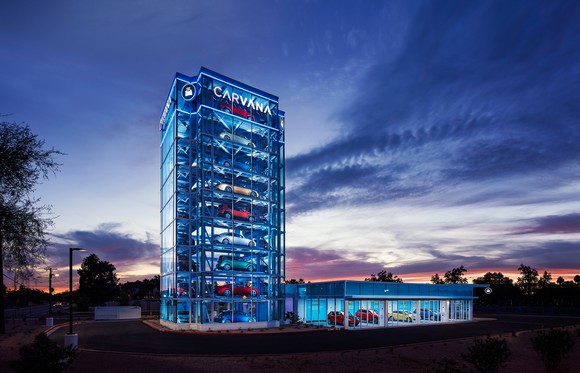
When considering what makes Carvana intriguing as a seller of used vehicles, the first thing that should grab investors' attention is its unique vending machine, which provides some differentiation and an element of fun compared to the traditional dealership experience. The company's most recently opened machine, its 12th, is in Tempe, Arizona, stands nine stories high, and holds up to 34 vehicles. Customers use an oversize coin to activate the vending process -- an experience worthy of sharing on social media, of course.

A nine-story glass building holding up to 34 cars.

Carvana's latest vending machine. Image source: Carvana Co.

For consumers who prefer a more traditional internet-based path to purchasing a vehicle, Carvana's website offers a quick and seamless experience with over 11,000 vehicle options, the ability for consumers to trade or sell their existing vehicle, and even personalized financing. Customers can schedule a delivery appointment as soon as the next day. It's a compelling way to purchase a used car and avoid the historical dealership experience.

What Carvana needs to do

Carvana's operations are innovative, but investors need more than that to buy in. And that's where Carvana must consistently show progress on gross profit per unit (GPU). We know Carvana is going to grow its top line as it enters into a slew of new�U.S. markets; in fact, Carvana's 44 markets at the end of the fourth quarter of 2017 are expected to explode to as many as 84 by the end of 2018. But it also needs to narrow the gap with its competitors on GPU. Let's use CarMax (NYSE:KMX), a competitor that logged an excellent 2018 first quarter,�as an example.�

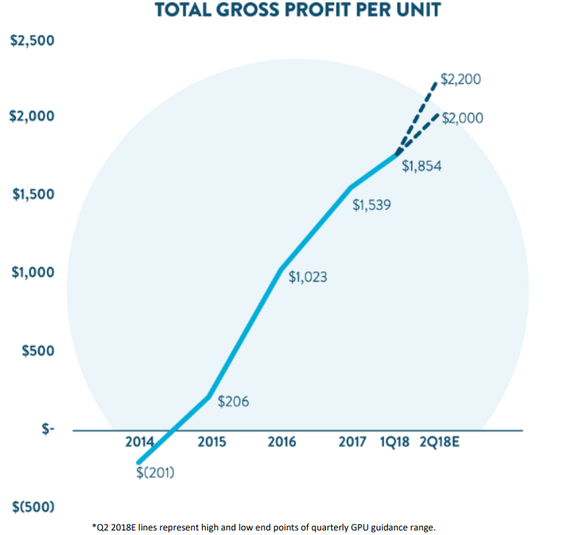
Carvana's retail used-car GPU checked in at $902 during the first quarter of 2018, a massive improvement from the prior year's $555, but a far cry from CarMax's $2,215 per unit. The story is much the same for both companies' wholesale vehicle GPU: Carvana's checked in at $73, another large improvement over the prior year's $19, but far below CarMax's $1,012. While Carvana has a long way to go to catch more established competitor CarMax in GPU, it has made substantial improvement since 2014.

Carvana's total GPU moving from a loss in 2014 to a projected $2,000 during 2018.

Image source: Carvana's May 9, 2018, letter to shareholders.

Carvana has made progress generating higher total GPU on the march toward its $3,000 medium-term�target, which narrows the gap between its Q1 2018 total GPU and CarMax's Q1 2018 total GPU of $3,333. To continue this, management needs to reduce average days to sale by increasing the number of markets it participates in, and the total sales, at a faster rate than it increases inventory. After management becomes satisfied with the rate of its market entry growth with levels of inventory, it then needs to grow into its inspection and reconditioning center capacity, and continue to increase inventory at a healthy rate. Carvana currently has four facilities with the collective capacity to inspect and recondition roughly 200,000 vehicles annually. For context, that's more than twice the 90,000 to 94,000 retail sales Carvana has forecast for 2018.�

Ultimately, if there's one metric investors need to keep an eye on, it's GPU. That's simply because we can expect, or at least certainly hope, that Carvana's top line will continue to post explosive growth as it aggressively expands into new markets. We can also expect expenses to rise as it does so, making profitability difficult in the near term. But for its long-term potential to reward shareholders, it must spend to enter new markets so it can grow into its capacity�and reach more consumers, while increasing inventory at a healthy rate to improve GPU at the same time -- that's how Carvana becomes a more lucrative business. And that's how investors will win in the long term.

Saturday, July 7, 2018

How To Talk Retirement With Your Spouse

&l;p&g;&l;img class=&q;dam-image shutterstock size-large wp-image-1125830159&q; src=&q;https://specials-images.forbesimg.com/dam/imageserve/1125830159/960x0.jpg?fit=scale&q; data-height=&q;640&q; data-width=&q;960&q;&g; Shutterstock

If you&a;rsquo;ve never talked about retirement with your spouse, you&a;rsquo;re not alone. But it&a;rsquo;s a crucial conversation if you want your retirement dreams to become reality.

Thirty-six percent of couples say they haven&a;rsquo;t even thought about a retirement plan, and 47% of couples disagree about how much money they&a;rsquo;ll need in retirement, according to a Fidelity Investments survey of 1,051 couples in 2015.

&a;ldquo;People are more comfortable talking about sex than money,&a;rdquo; says John Schwartz, author of &a;ldquo;This Is the Year I Put My Financial Life in Order&a;rdquo; and a reporter who covers climate change for The New York Times. &a;ldquo;It&a;rsquo;s so emotionally fraught that it&a;rsquo;s a topic a lot of people just avoid.&a;rdquo;

&l;strong&g;How to begin&l;/strong&g;

The million-dollar question that undergirds all other retirement questions is: Are your savings on track to support your desired future lifestyle? Working together to determine this, perhaps using a &l;a href=&q;https://www.nerdwallet.com/investing/retirement-calculator?utm_campaign=ct_prod&a;amp;utm_source=forbes&a;amp;utm_medium=mpsyn&q; target=&q;_blank&q;&g;retirement calculator&l;/a&g;, can help start the conversation.

Thinking about retirement can be tough for some people. They might associate it with getting old, or a relative&a;rsquo;s gloomy nursing home experience. If that&a;rsquo;s true for your spouse, plan your conversations carefully.

Don&a;rsquo;t bring up retirement when either of you is stressed or tired, says Syble Solomon, financial behavior specialist and creator of Money Habitudes, an online game for figuring out your attitude toward money.

&l;!--nextpage--&g;

Instead, talk about it on vacation, or over a nice meal.

Mary Ballin, a certified financial planner with Mosaic Financial Partners in Walnut Creek, California, recommends &a;ldquo;money dates,&a;rdquo; where couples set aside time &a;ldquo;to get away from the house and the load of laundry and the pile of dishes and the kids&a;rdquo; to discuss any money topic.

&l;strong&g;The power of open-ended questions&l;/strong&g;

Don&a;rsquo;t make demands when you talk with your spouse about retirement. Instead, ask open-ended, nonthreatening questions.

&a;ldquo;One way to start is when you see what&a;rsquo;s happening to people you know,&a;rdquo; Solomon says. If your neighbors just sold their house to travel around the country in an RV, ask your spouse, &a;ldquo;What do you think about that?&a;rdquo;

Another idea is to envision what retirement might look like. Ask your spouse, &a;ldquo;When you think about retirement, when you wake up in the morning, what time of day do you think you would wake up? What would you see out the window?&a;rdquo; Solomon says &a;mdash; maybe it&a;rsquo;s the beach, the mountains, or your current view.

&a;ldquo;You start talking about what are people&a;rsquo;s images, their expectations, their dreams,&a;rdquo; Solomon says.

But don&a;rsquo;t be surprised if you disagree on some points &a;mdash; or even many points.

&l;!--nextpage--&g;

&a;ldquo;You might have two totally different ideas about what you want to do in retirement,&a;rdquo; says Shelly-Ann Eweka, a director of financial planning at TIAA in Denver.

&a;ldquo;There&a;rsquo;s going to be some compromises,&a;rdquo; she says.

&l;strong&g;Getting specific&l;/strong&g;

After some initial discussions, you might be ready to address some more concrete questions together. Here are three questions to ask each other:

&l;strong&g;1. What will we do in retirement?&l;/strong&g;

People often forget to consider their day-to-day lives, says Rick Kahler, founder of Kahler Financial Group in Rapid City, South Dakota.

&a;ldquo;What I find they don&a;rsquo;t talk about is, &a;lsquo;What are our days going to look like?&a;rsquo;&a;rdquo; he says.

For example, maybe you want to travel and your spouse prefers to stay home and garden.

&l;!--nextpage--&g;

Differences around discretionary spending aren&a;rsquo;t necessarily a problem, says Jill Fopiano, chief executive officer at O&a;rsquo;Brien Wealth Partners. &a;ldquo;In some cases, one of the spouses travels a lot and the other doesn&a;rsquo;t,&a;rdquo; she says.

A trickier problem is disagreeing over major financial decisions, she says; for example, one spouse wants to downsize to a smaller house and the other doesn&a;rsquo;t. Resolving those issues may take considerable time and compromise.

&l;strong&g;2. When will we retire?&l;/strong&g;

Half of the couples surveyed by Fidelity disagreed on when they&a;rsquo;ll retire &a;mdash; a worrisome finding given that your retirement age is important in determining how much you need to save.

The good news? Figuring out at what age you want to retire can lead to deeper conversations. Having to wrestle with that and similar questions &a;ldquo;got us talking about money and our expectations and our desires,&a;rdquo; Schwartz says about him and his wife. &a;ldquo;It was a really valuable conversation.&a;rdquo;

Another important question: Will you retire at the same time? The answer can have serious implications for how and when you tap retirement savings and claim Social Security. Here are some ideas on &l;a href=&q;https://www.nerdwallet.com/blog/investing/take-social-security-benefits/?utm_campaign=ct_prod&a;amp;utm_source=forbes&a;amp;utm_medium=mpsyn&q; target=&q;_blank&q;&g;when to take Social Security benefits&l;/a&g;.

&l;strong&g;3. What are our top priorities?&l;/strong&g;

Your financial situation will determine what you can do in retirement, so it makes sense to prioritize what&a;rsquo;s most important.

&l;!--nextpage--&g;

&a;ldquo;Start prioritizing,&a;rdquo; Eweka says, &a;ldquo;and then ask: &a;lsquo;What is it going to take for us to afford it?&a;rsquo;&a;rdquo;

&a;ldquo;Realistically,&a;rdquo; she adds, &a;ldquo;if you have five things on your list, you may be able to get three of them done. That&a;rsquo;s why you prioritize. Or, you may be lucky &a;mdash; you might be able to do all five.&a;rdquo;

&l;strong&g;And if you&a;rsquo;re behind?&l;/strong&g;

The sooner you start saving, the better, because the power of compounding means your investment returns start building on themselves, making your job a lot easier.

One rule of thumb: If you have a 401(k) or similar plan at work, save enough there to get any company match. That&a;rsquo;s free money you don&a;rsquo;t want to pass up.

If you don&a;rsquo;t have a workplace plan, then setting up an IRA or Roth IRA is the next best thing. (We review &l;a href=&q;https://www.nerdwallet.com/blog/investing/the-best-ira-account-providers/?utm_campaign=ct_prod&a;amp;utm_source=forbes&a;amp;utm_medium=mpsyn&q; target=&q;_blank&q;&g;IRA providers here&l;/a&g;.)

If you&a;rsquo;re saving something now, consider bumping up your savings rate just a little bit every year. Even small increases can have a big effect over time. See how &l;a href=&q;https://www.nerdwallet.com/article/1-savings-hikes-can-spice-up-retired-life-by-1-million?utm_campaign=ct_prod&a;amp;utm_source=forbes&a;amp;utm_medium=mpsyn&q; target=&q;_blank&q;&g;1% savings hikes can spice up your retired life by $1 million&l;/a&g;.

&a;nbsp;&l;/p&g;

Thursday, July 5, 2018

Sell This 17% Dividend Yield and Buy This High-Yield Income Stock Instead

Having invested in the stock market for 20 years now, I've learned one valuable lesson: The best portfolios are almost always filled with high-quality dividend stocks. Aside from the fact that dividend stocks outperform their nondividend-paying brethren over the long run, the former offer a bevy of advantages to investors.

The give-and-take of high-yield investing

To start with, a company that pays a regular dividend is sending a message to Wall Street and investors that it has a time-tested business model capable of consistently generating profits. It's unlikely that a board of directors would share a percentage of a company's income with investors if that board didn't foresee many more years of healthy profits and/or growth.

A businessman placing hundred dollar bills into someone's outstretched hands.

Image source: Getty Images.

Secondly, dividends are great for helping to partially offset the inevitable declines associated with stock market corrections and bear markets. Even though stocks spend far more time in a bull market than in correction, downside at some point in the future is inevitable. Dividends can help lessen the magnitude of this downside.

And, perhaps most importantly, a regularly paid dividend can be reinvested back into more shares of dividend-paying stock. This can lead to successively more shares of stock being owned, and larger dividend payments being received, in a repeating pattern. This "trick" is what most money managers lean on to pump up the long-term returns of their clients.

But therein lies the rub with dividend stocks: We want the highest yield possible, but with virtually no risk. Unfortunately, yield and risk tend to go hand in hand. In other words, the higher the yield, the more likely it proves unsustainable.

One of the key reasons this is the case is because yield is a function of price. If, for instance, a publicly traded company's share price is halved, its dividend yield will double, probably making it more attractive to income-seeking investors. But if there's an underlying issue with the company's business model, a growing yield may prove to be nothing more than a trap for income investors.

In short, investing in high-yield dividends -- traditionally defined as those with an annual yield of at least 4% -- requires extra scrutiny on the part of investors.

An investor touching the sell button on a digital screen.

Image source: Getty Images.

It's time to sell this 17% yield stock

As a case in point, consider BP Prudhoe Bay Royalty Trust (NYSE:BPT), which is currently paying out an extrapolated $5.10 a year, based on the $1.275 per share it divvied out in April. This is good enough for a better than 17% annual yield, albeit it should be noted that the Trust's payout differs each quarter depending on its royalty revenue and cash earnings.�

Generally speaking, a 17% yield is mouthwatering. At this rate of return, reinvesting your dividends should, in theory, lead to a complete repayment of your initial investment in less than five years, assuming the share price remains static. But BP Prudhoe Bay Royalty Trust is one of those aforementioned yield traps that investors should probably consider running away from.

The Trust's business model is very straightforward. It receives a percentage of production from BP's (NYSE:BP) Prudhoe Bay Alaska operations. This percentage is capped to the first 90,000 barrels per day of production. Given that the Trust's costs tend to be predictable -- concessions to BP and administrative expenses represent the bulk of its costs -- BP Prudhoe Bay Royalty Trust's dividend tends to be intricately tied to the price of oil. If West Texas Intermediate (WTI) significantly increases in price, then the Trust's ability to net more in cash earnings allows it to pay a beefier dividend.

Barrels of crude oil lined up in a row.

Image source: Getty Images.

Though consistently rising WTI prices have helped lift the share price and aggregate payout of the Trust in recent quarters, there are still reasons for investors to be concerned. For example, the Trust is only expected to last through 2028, whereupon the share price will effectively head to $0 (although this termination date has been fluid in recent years). This means investors have to hope they'd receive more in aggregate dividends between now and 2028 in order to walk away having made money. That might seem easy to do with a greater than $5 annual extrapolated payout, but keep in mind that production is starting to fall.

According to BP Prudhoe Bay Royalty Trust's 10-Q filing, average net production during the first quarter was just 84,000 barrels per day (bpd), down from 91,800 bpd in the year-ago quarter. What's more, the Trust has consistently produced less than 90,000 bpd annually since 2015, and anticipates that production will come in below this level on an annual basis "in most future years." This means that WTI would probably need to rise significantly in order to make this Trust a viable intermediate-term investment -- and, frankly, I don't have that type of confidence.�

And, as icing on the cake, weaker crude prices in March 2016 coerced BP to reduce its rig count in Prudhoe Bay by more than half to just two rigs.�This looks to be a high-yield income stock to avoid.

An investor circling the word buy under a dip in a stock chart.

Image source: Getty Images.

This 11% yield looks mighty attractive

On the other hand, there are companies with a double-digit dividend yield that are legitimately attractive and probably sustainable. Instead of looking at BP Prudhoe Bay Royalty Trust, I'd suggest sticking within the commodity arena and considering coal producer Alliance Resource Partners (NASDAQ:ARLP), which is currently yielding 11.5%.

I know what you're probably thinking: "Isn't coal going the way of the dodo bird?" While you are correct that coal has lost substantial ground to cleaner-burning natural gas and has seen renewable energies like solar and wind begin to claw their way up the ranks, it's not exactly a source of energy that's at risk of disappearing anytime soon -- especially with oil and natural gas now well off their 2016 lows. According to the U.S. Energy Information Administration, 1.2 billion kilowatt-hours of electricity was generated with coal in 2017, working out to a 30.1% share. That trailed natural gas (31.7%), but was ahead of nuclear (20%) and all renewables combined (17.1%). In other words, coal remains relevant, even if lacks the flare of renewable energy.�

What makes Alliance Resource Partners so special is the company's focus on the future, as well as its balance sheet.

When I say "focus on the future," I have two specific meanings. First, the company does an excellent job of locking in volume and pricing commitments for the future. As of the end of its most recent quarter, it had 38 million tons of secured volume and price commitments in 2018 to go along with 17.5 million tons, 11.7 million tons, and 4.8 million tons, in 2019, 2020, and 2021, respectively. For added context, the company expects coal production volume of 40 million tons to 41 million tons in 2018.�Securing deals well in advance ensures predictable cash flow and minimizes the company's exposure to wholesale fluctuations in the price of thermal and/or metallurgical coal.

An excavator loading a dump truck in an open-pit mine.

Image source: Getty Images.

But I also refer to Alliance Resource Partners' export push when I reference its "focus on the future." In 2018, 7.1 million tons of its 38 million in secured volume is headed overseas -- a new record. Last year, it shipped 6.3 million tons to international markets, most of which was thermal coal.�Developing overseas markets are likely to be reliant on coal for decades after the U.S. pushes toward renewable reliance, meaning Alliance Resource Partners is angling to secure its position as a global export leader.

Finally, the company's balance sheet is in far better shape than its debt-riddled peers. With less than $480 million in net debt, the company's 40% debt-to-equity ratio gives it the financial flexibility to make acquisitions, or adjust its output, as management sees fit.

While coal may not be an ideal industry to look for a solid dividend stock, I believe you'd struggle to find a company with a yield north of 10% that's more promising than Alliance Resource Partners.