Friday, March 29, 2019

For small charities, the new tax law looms large

People don't necessarily give to charity because of tax benefits, but it doesn't hurt.

However, the new tax law, among other things, has eliminated or sharply reduced the benefits of charitable giving for many would-be donors.

Even though the deduction for donations is unchanged, you still need to itemize to claim it, and that's a much higher bar with the now nearly doubled standard deduction.

Under the new law, an individual will need total itemized deductions to exceed $12,000, the new standard deduction for individual taxpayers, up from the former $6,350 standard deduction. Married couples would need deductions exceeding $24,000, up from $12,700.

As a result, fewer people will likely itemize this year, which means many won't reap the tax benefits of their charitable contributions.

One analysis from the Tax Policy Center found that 21 million taxpayers will stop taking the charitable deduction under the Tax Cuts and Jobs Act. Not only did the number of taxpayers itemizing shrink, but lower tax rates reduced the marginal benefit of giving, as well, the Tax Policy Center said.

Troubling signs

That could put a damper on some people's charitable spirit.

That's particularly troubling for grassroots charities such as the Community Partnership School, a brand-new independent school located in one of Philadelphia's most disadvantaged neighborhoods.

Student enrollment is made possible almost entirely by charitable donations, which cover about 95 percent of the school's operating budget.

"Whether it's $1 million or $10 — it all matters, that's how we fund the school," said Eric Jones, the head of school.

Eric Jones Community Partnership School's Head of School answering questions from students. CNBC Eric Jones Community Partnership School's Head of School answering questions from students.

The average donation is in the $500 range, Jones said, which is not uncommon for smaller nonprofits. Those are also the gifts that could be hardest hit going forward.

Early numbers for 2018 show a near 3 percent increase in large gifts, defined as $1,000 or more. But modest gifts between $250 and $999 fell by 4 percent and gifts under $250 dropped by more than 4 percent, according to the Fundraising Effectiveness Project's 2018 fourth-quarter report.

Of course, people don't give to charity just to get a tax deduction. And there is a way for smaller donors to preserve the tax advantage of their donations, despite the new, higher standard deduction.

With a strategy called "bunching," you can save money over time and donate every two or three years instead of every year.

"Under the new tax law, charitable giving is a relative bright spot for donors who itemize." -Kim Laughton, president of Schwab Charitable

One way to accomplish this is with a donor-advised fund, which lets you make a charitable contribution and receive an immediate tax break for the full donation, and then recommend grants from the fund to your favorite charities over time.

For example, instead of giving $5,000 to charity annually, accelerate the gift by giving $10,000 every two years. This way, you may get your itemized deductions over the limit one year and take the standard deduction the next.

In fact, more clients are using donor-advised funds now for just this reason, according to Kate Kennedy, a certified financial planner and partner at Cerity Partners in Chicago. "It's one of the few things we can control as far as the tax benefit," she said.

Schwab Charitable, a provider of donor-advised funds, reported a record $2.2 billion in grants to charities in 2018 — a 35 percent increase from the previous year. That means that, through the end of last year, donors continued to contribute to their donor-advised fund accounts and then recommend grants to the charities of their choice.

Fidelity Charitable similarly reported a record $5.2 billion in grants in 2018, a 17 percent increase over 2017.

More from Personal Finance:
Heavily invested in stocks, boomers risk retirement savings
Good news for borrowers: Here's how to improve your credit score
Savings accounts outperformed the stock market

"Under the new tax law, charitable giving is a relative bright spot for donors who itemize because the charitable deduction was preserved while several other popular deductions were capped or eliminated" said Kim Laughton, the president of Schwab Charitable.

However, on closer look, the total number of contributions went down year over year while the dollar amounts went up, Laughton said, which means those gifts came from fewer — and richer — givers.

"The wealthier folks are continuing to give," Laughton said. "The charitable deduction is still a powerful tool at their disposal."

"We'll have wealthy people giving a lot and people of modest wealth giving less, and I don't think that's a good trend," said Eileen Heisman, the president and CEO and the National Philanthropic Trust. "We're going to have a big division of the haves and have-nots."

Tuesday, March 26, 2019

Make a 150% Gain with This Stock's "Golden Cross" Pattern

This site uses Akismet to reduce spam. Learn how your comment data is processed.

The stock market keeps edging higher this year, but we've zoomed in on one stock that just flashed a lucrative "golden cross" indicator. That could mean a potential 150% gain for investors who know how to play it. You're going to know just how to do it too.

Money Morning Quantitative Specialist Chris Johnson sees the S&P 500's move above the 2,800 level as being quite positive.

Since October, this price level, give or take a few points, stopped at least four rally attempts. But as they say, the stronger the resistance, the stronger the market will be when it finally punches through.

And it punched through last week.

The rally that began in December of last year still has room to run higher, even with the small pullbacks that are inevitable along the way.

That's creating new opportunities for bullish trades, and we've uncovered one biotech stock that could shoot higher during this rally.

Chris Johnson is a quantitative analyst, which means he looks at data generated by the market, runs it through his proprietary algorithms, and then trades based on the unemotional results. His analysis led him to the biotech sector, where he pinpointed a stock with the potential to break out even higher to the upside.

The stock he found is Epizyme Inc. (NASDAQ: EPZM).

7-Day Cash Course: With the secrets in this video series, you could potentially start collecting anywhere from $1,190, $1,313, and even $2,830 in consistent income – each and every week. And it can be yours for only $1…

The company is in biopharmaceuticals and is working on medicines that target various cancers, especially non-Hodgkin's lymphoma. The stock has a market capitalization of $957 million, which puts it right in the middle of the small-cap sector.

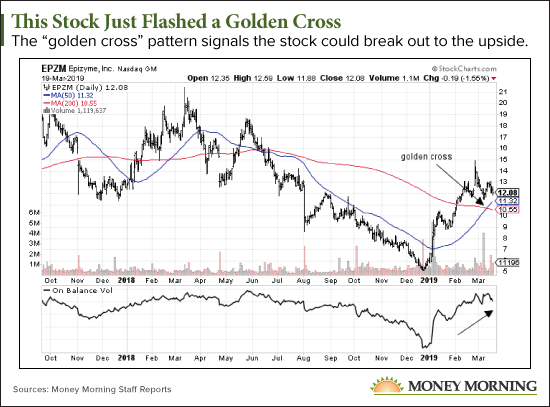
Despite its rather choppy movement over the past month, technical indicators called moving averages show bullish signs. Johnson noted that the stock recently formed a "golden cross," which suggests that the major trend has turned to the upside. Specifically, a golden cross occurs when the 50-day average moves above the 200-day average.

You can see this bullish pattern in the chart below…

golden cross

Put another way, the 50-day average, which is more sensitive to market movements, crosses above the 200-day average – a sign the stock price is moving quickly higher. This can only happen after a sustained advance and, more often than not, a breakout through trendlines drawn on the chart.

The opposite occurs when the short average drops below the long average. This is called a "black cross" or "death cross." As you can tell from the names, it is not good for investors.

Not all golden crosses result in a big move higher in the stock price, but no major rally can happen without one. For a stock that was trending lower, as Epizyme did for most of 2018, it really is the light at the end of the tunnel.

The chart patterns tell us which way the trend is pointing and how strong it is. In this way, we combine quantitative signals with technical signals for a one-two punch and much higher odds of success.

But aside from moving averages, we can also measure how aggressive bulls and bears are when they buy and sell. Although we cannot ask every investor how they feel about the stock, we can look for the signs they leave behind thanks to their activity.

For example, if bulls are more aggressive and feeling feisty, we see more activity taking place at the stock's ask price than at its bid price. In other words, bulls want the stock, and they are willing to pay up for the privilege of owning it.

If we add up all the shares that traded during the day when the price ticked higher from the previous trade and subtract all the shares that traded when the price ticked lower, the result will be a good proxy for supply and demand. When more shares change hand as the price moves higher, it is bullish.

And that is what we see in Epizyme over the past month, even though price action was choppy.

This indicator is called on-balance or cumulative volume, and it tells us that bulls are more aggressive than bears and money is flowing into the stock.

The more signals we can piece together, the better our overall forecast will be.

Johnson sees the stock reaching $15 per share in the near term for a $3.02 gain per share.

A $3 gain may not seem like much, but for a stock trading at $11.98, that represents a 25% profit.

But you can amplify these gains by using options.

And the trade we're going to show you offers over 100% upside…

Turn a 25% Gain into 100% Profits with This Options Trade

Join the conversation. Click here to jump to comments…

Saturday, March 23, 2019

FedEx earnings could save this lagging sector

FedEx is set to report earnings after the bell.

A solid earnings report could lift one lagging group: the industrials. Weighed on by Boeing's recent sell-off, it is the only S&P sector in the red in March with losses of nearly 2 percent.

Mark Tepper, president and CEO of Strategic Wealth Partners, said FedEx and the freight and logistics slice of the industrials should continue to drive higher.

"We want to take advantage of all this e-commerce growth that we're expecting, and right now e-commerce sales as a percentage of total retail sales is around 12, 13 percent. By 2025 it should be around 25 percent of total sales," Tepper said Monday on CNBC's "Trading Nation."

FedEx, in particular, looks best positioned to capture that growth, he said.

"The stock has been completely crushed because of this possible threat from Amazon logistics. But I think that's overdone. FedEx is well-aware of it and they're making moves to counter it already," Tepper said. "International weakness has been an issue for them and it's still a concern going forward but I do believe the worst is behind us so it seems as though all the bad news is already baked in."

FedEx has tumbled 27 percent over the past 12 months, far worse than the XLI industrial ETF's 1 percent decline. It is 31 percent off its 52-week high.

Ari Wald, head of technical analysis at Oppenheimer, said a different name in industrials looks the best positioned to move higher.

"One name that stands out is Ametek," Wald said Monday on "Trading Nation." "You can see the stock getting ready to break through resistance versus the S&P 500. This stock has a 200-day moving average that is starting to turn higher, that's why we'd play for that breakout."

Industrials equipment maker Ametek hit a record high Tuesday. It has risen more than 3 percent this month as the XLI ETF has tumbled 2 percent.

Disclaimer

Friday, March 22, 2019

China Wants To Dominate The Indo-Pacific Region, Silently

&l;p&g;&l;img class=&q;dam-image ap size-large wp-image-b5f5fe3f336b4664b98ceff4d8b56dc0&q; src=&q;https://specials-images.forbesimg.com/dam/imageserve/b5f5fe3f336b4664b98ceff4d8b56dc0/960x0.jpg?fit=scale&q; data-height=&q;589&q; data-width=&q;960&q;&g;

China has a clear mission in Indo-Pacific region: complete dominance, in a silent way. US shouldn&s;t let it happen.

&a;nbsp;

That&a;rsquo;s according to&a;nbsp;&a;ldquo;The Stealth Superpower: How China Hid Its Global Ambitions,&a;rdquo;&a;nbsp;published in the January/February issue of&a;nbsp;&l;em&g;Foreign Affairs&l;/em&g;.

&a;nbsp;

&a;ldquo;Although China does not want to usurp the United States&a;rsquo; position as the leader of the global order, its actual aim is nearly as consequential,&a;rdquo; says Oriana Skylar Mastro&a;nbsp;in the article. &a;ldquo;In the Indo-Pacific region, China wants complete dominance.; it wants to force the United States out and become the region&a;rsquo;s unchallenged political, economic, and military hegemon.&a;rdquo;

&a;nbsp;

That&a;rsquo;s a major geopolitical event that casts a shadow over financial markets of the region, as it raises the potential of a regional war that will devastate the region. In fact, the prospect of a South China Sea war was included in the list of the top ten geopolitical risks compiled by the Economist.

&l;img class=&q;size-large wp-image-19672&q; src=&q;http://blogs-images.forbes.com/panosmourdoukoutas/files/2019/03/koyfin_20190316_122324483-1200x600.jpg?width=960&q; alt=&q;&q; data-height=&q;600&q; data-width=&q;1200&q;&g; Philippines, Vietnam, and China Shares

China&a;rsquo;s quest for control&a;nbsp;in this part of the globe&a;nbsp;happened&a;nbsp;in a silent way. &a;ldquo;Chinese leaders have recognized that in order to succeed, they must avoid provoking an unfavorable response, and so they have refrained from directly challenging the United States, replicating its order-building model, or matching its globally active military,&a;rdquo; she writes.

&a;nbsp;

Instead, they have been building highways, like the China Pakistan Economic Corridor, a western route to the Indian Ocean;&a;nbsp;&a;nbsp;taking over strategic ports in the Sri Lanka and Pakistan; and eyeing the Philippines ports.

&a;nbsp;

Wait, there&a;rsquo;s more. There are China&a;rsquo;s alliances.

&a;nbsp;

&a;ldquo;We should also take into account here the close relationship and ties that have developed for decades between China and North Korea,&q; says&a;nbsp;Stathis Giannikos from Athens-based Pushkin Institute. &q;North Korea is a wild card in this part of the world and not only.&a;rdquo;

And when the &a;ldquo;silent&a;rdquo; strategy doesn&a;rsquo;t work, China&a;nbsp;has turned&a;nbsp;to a &a;ldquo;loud&a;rdquo; strategy. That has been the case with the Philippines where Beijing has been&a;nbsp;threatening Manila with war should it enforce a UN ruling against China&a;rsquo;s territorial claims in the South China Sea.

&a;nbsp;

Beijing&a;rsquo;s Indo-Pacific ambitions, and especially the South China Sea claims, are hardly new. What&a;rsquo;s new is Beijing&a;rsquo;s drive in asserting those claims.

&a;nbsp;

&a;ldquo;In recent years&a;hellip; China has begun to assert its claims more vigorously and is now poised to seize control of the sea,&a;rdquo; says Ely Ratner, in the July/August 2017 issue of&a;nbsp;&l;em&g;Foreign Affairs&l;/em&g;. &a;ldquo;Should it succeed, it would deal a devastating blow to the United States&a;rsquo; influence in the region, tilting the balance of power across Asia in China&a;rsquo;s favor.&a;rdquo;

&a;nbsp;

What should the US do?

&a;nbsp;

State openly that it will help countries like the Philippines defend their claims against China, according to Ratner.

&a;nbsp;

&a;ldquo;It should supplement diplomacy with deterrence by warning China that if it continues, the United States will abandon its neutrality and help countries in the region defend their claims,&a;rdquo; he says. &a;ldquo;Washington should make it clear that it can live with an uneasy stalemate in Asia&a;mdash;but not with Chinese hegemony.&a;rdquo;

&a;nbsp;

In fact, that&a;rsquo;s what the&a;nbsp;US&a;nbsp;did recently in Manila. But it doesn&a;rsquo;t seem sufficient to convince Philippines President Rodrigo Duterte to make yet another flip-flop on Philippines foreign policy.

&l;/p&g;

Thursday, March 21, 2019

Top China Stocks To Invest In Right Now

tags:TISA,ATAI,FMCN,BIDU,NTES,

Monday was a positive day on Wall Street, as major benchmarks jumped following an uneventful weekend, tapering their gains as the session came to a close. Some had feared that China might retaliate once again after the U.S. issued a second round of tariffs against the nation with the world's second-largest economy, but the expected fireworks didn't come, putting market participants more at ease. The beginning of earnings season in the next week will also distract investors from geopolitical issues, perhaps allowing indexes to climb further. Yet some individual stocks had difficulties that sent their shares lower. Yandex (NASDAQ:YNDX), Menlo Therapeutics (NASDAQ:MNLO), and MGIC Investment (NYSE:MTG) were among the worst performers on the day. Here's why they did so poorly.

Yandex takes a hit on Russian sanctions

Shares of Yandex sank 12% as the entire Russian stock market suffered from the imposition of new U.S. sanctions on its Cold War rival. The sanctions targeted about two dozen Russian government officials and oligarchs, with Treasury Secretary Steve Mnuchin accusing Russia of supporting the Assad regime in Syria, continuing to remain in Crimea, and generally attacking the concept of Western democracy. Yandex wasn't directly targeted under the sanctions, but the internet website stands to lose generally if sanctions create a sustained slump in economic activity more generally. The news is especially ill-timed given Yandex's recent moves higher toward levels not seen since the early 2010s, but political risk is an ever-present danger for investors in Russia.

Top China Stocks To Invest In Right Now: Top Image Systems Ltd.(TISA)

Advisors' Opinion:
  • [By Money Morning Staff Reports]

    Before we get to our latest pick, here are last week's top-performing penny stocks:

    Penny Stock Sector Current Share Price Last Week's Gain Melinta Therapeutics Inc. (NASDAQ: MLNT) Healthcare $1.74 104.01% Pernix Therapeutics Holdings Inc. (NASDAQ: PTX) Healthcare $0.83 84.40% Top Image Systems Ltd. (NASDAQ: TISA) Healthcare $0.82 59.85% Jason Industries Inc. (NASDAQ: JASN) Healthcare $2.21 58.99% Maxwell Technologies Inc. (NASDAQ: MXWL) Financial $4.66 51.79% Marathon Patent Group Inc. (NASDAQ: MARA) Healthcare $0.52 51.47% Forward Pharma A/S (NASDAQ: FWP) Basic Materials $1.53 43.57% Dixie Group Inc. (NASDAQ: DXYN) Healthcare $1.40 42.86% Trevena Inc. (NASDAQ: TRVN) Services $1.41 39.60% Alliance MMA Inc. (NASDAQ: AMMA) Healthcare $4.95 36.18%

    Don't Miss Out: The Treasury is sitting on an $11.1 billion cash pile, and a loophole entitles Americans to a sizable portion. Some are collecting $1,795, $3,000, or $5,000 every month thanks to this powerful investment…

  • [By Joseph Griffin]

    Get a free copy of the Zacks research report on Top Image Systems (TISA)

    For more information about research offerings from Zacks Investment Research, visit Zacks.com

  • [By Ethan Ryder]

    Get a free copy of the Zacks research report on Top Image Systems (TISA)

    For more information about research offerings from Zacks Investment Research, visit Zacks.com

  • [By Shane Hupp]

    Get a free copy of the Zacks research report on Top Image Systems (TISA)

    For more information about research offerings from Zacks Investment Research, visit Zacks.com

Top China Stocks To Invest In Right Now: ATA Inc.(ATAI)

Advisors' Opinion:
  • [By Paul Ausick]

    ATA Inc. (NASDAQ: ATAI) traded down about 14% Monday to set a new 52-week low of $0.82, based on revalued shares that closed at $0.72 on Friday but traded up about 250% on Monday at $2.53. Volume was more than 200 times the daily average of around 42,000. You’re on your own here to figure this one out.

Top China Stocks To Invest In Right Now: Focus Media Holding Limited(FMCN)

Advisors' Opinion:
  • [By Stephan Byrd]

    An issue of Focus Media Holding Limited (NASDAQ:FMCN) debt fell 1.1% against its face value during trading on Tuesday. The debt issue has a 7.5% coupon and is set to mature on April 1, 2025. The debt is now trading at $97.63 and was trading at $98.50 last week. Price changes in a company’s debt in credit markets sometimes anticipate parallel changes in its stock price.

  • [By Stephan Byrd]

    An issue of Focus Media Holding Limited (NASDAQ:FMCN) debt fell 1.7% against its face value during trading on Friday. The high-yield debt issue has a 7.5% coupon and is set to mature on April 1, 2025. The debt is now trading at $94.25 and was trading at $96.38 one week ago. Price changes in a company’s debt in credit markets sometimes predict parallel changes in its share price.

    WARNING: “Focus Media (FMCN) Bond Prices Fall 1.7%” was first published by Ticker Report and is the sole property of of Ticker Report. If you are reading this piece of content on another site, it was illegally copied and reposted in violation of US & international trademark and copyright legislation. The correct version of this piece of content can be read at https://www.tickerreport.com/banking-finance/4207523/focus-media-fmcn-bond-prices-fall-1-7.html.

    About Focus Media (NASDAQ:FMCN)

  • [By Stephan Byrd]

    An issue of Focus Media Holding Limited (NASDAQ:FMCN) bonds fell 0.9% against their face value during trading on Monday. The high-yield debt issue has a 7.25% coupon and will mature on April 1, 2023. The bonds in the issue are now trading at $99.13 and were trading at $98.13 last week. Price moves in a company’s bonds in credit markets sometimes anticipate parallel moves in its share price.

Top China Stocks To Invest In Right Now: Baidu Inc.(BIDU)

Advisors' Opinion:
  • [By Leo Sun]

    Baidu (NASDAQ:BIDU) owns China's top search engine and a sprawling network of portals, apps, and cloud services. The company is widely considered the 800-pound gorilla of the Chinese internet advertising market, and a major investor in next-gen AI and driverless technologies.

  • [By Billy Duberstein]

    There are three clear leaders riding this wave, all of which have ties to the "big three" of China, or the "BAT": Baidu (NASDAQ:BIDU), Alibaba (NYSE:BABA), and Tencent (NASDAQOTH:TCEHY). For investors interested in riding the Chinese streaming video trend, the following are definitely the stocks to own.

  • [By Douglas A. McIntyre]

    The United States is only one problem of many Ford faces. Among others is tumbling sales in China, the world’s largest car market. It has set a partnership with Chinese tech company Baidu Inc. (NASDAQ: BIDU). From the Ford press release, it is hard to see how this will work:

Top China Stocks To Invest In Right Now: Netease.com Inc.(NTES)

Advisors' Opinion:
  • [By Stephan Byrd]

    Alibaba Group (NASDAQ: NTES) and NetEase (NASDAQ:NTES) are both large-cap retail/wholesale companies, but which is the superior investment? We will compare the two businesses based on the strength of their institutional ownership, dividends, risk, earnings, profitability, analyst recommendations and valuation.

  • [By Leo Sun]

    Shares of NetEase (NASDAQ:NTES) recently tumbled after the Chinese tech company posted mixed first-quarter numbers. Its revenue rose 4% annually to 14.2 billion yuan ($2.3 billion), which beat estimates by $120 million. Unfortunately, its non-GAAP net income plunged 69% to 1.34 billion yuan ($213 million), or $1.61 per diluted ADS (American depositary share) -- which missed estimates by 36 cents.

  • [By Shane Hupp]

    These are some of the news headlines that may have effected Accern’s rankings:

    Get NetEase alerts: Study Stock Price Behavior with Financial Report for NetEase, Inc. (NTES) (finherald.com) Analysis of Analyst Stock Recommendation: NetEase, Inc. (NTES) (nasdaqplace.com) Notable Moving Tech Stock: NetEase, Inc. (NTES) (nasdaqplace.com) Investors must not feel shy to buy these Stocks: NetEase, Inc. (NASDAQ:NTES), YUM! Brands, Inc. (NYSE:YUM), Erie … (journalfinance.net) Destiny maker Bungie raises $100M from China's NetEase to build new games (geekwire.com)

    NetEase traded up $3.95, hitting $243.58, during midday trading on Friday, MarketBeat.com reports. The stock had a trading volume of 1,182,914 shares, compared to its average volume of 1,423,698. The firm has a market cap of $31.99 billion, a price-to-earnings ratio of 19.63, a PEG ratio of 1.83 and a beta of 0.82. NetEase has a 1-year low of $222.32 and a 1-year high of $377.64.

  • [By Anders Bylund]

    Chinese online media giant NetEase Inc. (NASDAQ:NTES) is hardly the talk of the town. Sporting a $30 billion market cap, NetEase works in a consumer-facing industry, and share prices have bounced between $222 and $378 over the last year. And these are the hallmarks of the market's most-discussed tickers.

  • [By Leo Sun]

    NetEase (NASDAQ:NTES) reported its fourth-quarter earnings on Feb. 20. Its revenue rose 36% annually to RMB 19.84 billion ($2.89 billion), which missed the USD guidance by $20 million but marked its third straight quarter of accelerating sales growth.

  • [By Asit Sharma]

    Shares of NetEase, Inc. (NASDAQ:NTES) have dipped 26.8% in the first six months of 2018, according to data from S&P Global Market Intelligence.

Wednesday, March 20, 2019

Too Many People Are Making This Retirement Mistake

There's a world of mystery surrounding retirement for those who aren't quite there yet. Still, one thing's for sure: Your golden years are apt to cost money, and if you want to live comfortably, you'll need the income to support your desired lifestyle.

But a frightening number of U.S. adults are making a major mistake that could destroy their chances of ever getting to retire in the first place: not saving for their golden years. A whopping 42% of Americans don't contribute to a retirement plan, according to the Center for Financial Services Innovation, and if you're one of them, you might be in for a rude awakening.

Retirement: It's more expensive than you think

Many people don't save for retirement because they assume they don't need that much money during their golden years, especially if their mortgages are paid off by then and they don't have commuting costs to contend with. But when you think about the things you spend money on today, you might realize that most of them will still apply when you're older. Take home repairs, maintenance, property taxes, and insurance -- even if you're mortgage-free in retirement, there are other costs associated with owning a home. And if you choose not to own one, you'll need to pay somebody rent.

Man covering his face.

IMAGE SOURCE: GETTY IMAGES.

Then there's transportation -- you need a means of getting around town, whether it's owning a vehicle or paying for taxis, rideshares, or the bus. You also need heat, electricity, water, phone service, food, and clothing, just to list some more essentials. And don't forget healthcare -- the one expense that's likely to go up as you age.

That's why you need savings earmarked for retirement, and if you don't accumulate some, you're apt to struggle down the line. And if you think Social Security will suffice in paying your bills, think again. Those benefits are only designed to replace about 40% of your pre-retirement income (assuming you were an average earner), but most seniors need close to double that amount to live decently.

Remember, too, that in addition to the aforementioned necessities, you'll also need money in retirement to occupy your newfound free time. Not having enough of it to pay for things like cable, leisure, or the occasional vacation could turn your golden years into one extended period of disappointment.

The solution? Start carving out money each month to contribute to a retirement plan, whether it's an IRA or 401(k). You don't necessarily need to part with thousands of dollars each month (though the more you can save, the better) -- you just need to save enough to buy yourself some financial security and flexibility later in life. Check out the following table, which shows how much savings you might accumulate if you were to set aside a series of modest amounts over time:

Monthly Savings Contribution

Total Accumulated Over 30 Years (Assumes a 7% Average Annual Return)

$200

$227,000

$300

$340,000

$400

$453,000

$500

$567,000

TABLE AND CALCULATIONS BY AUTHOR.

Note that the above calculations assume a 30-year savings window, which means that even if you're nearing age 40 with no retirement savings to show for, you have a reasonable opportunity to catch up. And if you're wondering about that 7% return, it's actually a couple of percentage points below the stock market's average. If you have 30 years to invest your money, you should feel reasonably comfortable going heavy on stocks, since you'll have plenty of time to ride out the market's ups and downs.

Of course, there are other savings options you might have to play around with, too. If you're already in your 50s, for example, and don't have a dime in your IRA or 401(k), you'll need to set aside more money each month to accrue a decent sum for your golden years. You might also need to postpone retirement a few years to build additional cash reserves.

No matter what strategy you adopt for building savings, don't assume that retirement will cost you very little money, and definitely don't assume that Social Security will manage to pay for it. If you allow yourself to fall victim to either myth, there's a good chance you'll end up cash-strapped, stressed, and bored during a period of life you should really be enjoying.

Friday, March 15, 2019

D-Street Buzz: Yes, IndusInd Bank extend gains, ICICI Bank at new 52-week high

The benchmark stock market has managed to stay in the positive territory with Nifty up 25 points, trading at 11,326, and Sensex gaining 167 points, trading at 37,703.

Bank Nifty extended the early gains, up over 1 percent led by IndusInd Bank that jumped 4 percent followed by HDFC Bank that was up 2 percent. The other gainers were YES Bank, State Bank of India and ICICI Bank.

From the PSU banking space, the top gainers were J&K Bank, Canara Bank, Syndicate Bank and Bank of Baroda.

Selective real estate stocks were also buzzing led by DLF, Indiabulls Real Estate, Prestige Estates and Sunteck Realty.

related news Buy or Sell | Nifty likely to head towards 10380; Petronet, Axis Bank top buys Keerthi Industries locked at upper circuit after on contract wins in KG basin

Nifty PSE was down 1 percent dragged by Coal India, NALCO, NTPC, Oil India, ONGC and SAIL.

From the auto space, the top losers were Bosch, Motherson Sumi Systems, Maruti Suzuki, Tata Motors and Tata Motors DVR.

Metals stocks were also trading in the red dragged by SAIL, down 4 percent while Vedanta, Tata Steel, NALCO, Jindal Stainless, JSPL, JSW Steel, Coal India and Hindustan Copper were the other losers.

Media stocks also traded lower as Zee Entertainment, Dish TV, EROS International Media, Jagran Prakashan, Network18, PVR, Sun TV Network and TV Today fell in day's trade.

From the midcap space, the top losers were KIOCL, SAIL, Kansai Nerolac, Apollo Hospitals and NALCO while the top gainers were Container Corporation, GE T&D, Bharat Forge and AU Small Finance Bank.

The top gainers from NSE included IndusInd Bank, YES Bank, HDFC Bank, HPCL and Bajaj Finance while the top losers included Bharti Airtel, IOC, Zee Entertainment, Vedanta and Indiabulls Housing Finance.

The most active stocks were Reliance Industries, HDFC Bank, YES Bank, IndusInd Bank and Infosys.

Reliance Industries, Axis Bank, Bajaj Holdings, Havells India, Info Edge, Godfrey Phillips, UPL and The Indian Hotels have hit 52-week high on NSE in the afternoon session.

The breadth of the market favoured the declines with 628 stocks advancing and 1,092 declining while 357 remained unchanged. On the BSE, 1058 stocks advanced, 1,556 declined and 152 remained unchanged.

Disclosure: Reliance Industries Ltd. is the sole beneficiary of Independent Media Trust which controls Network18 Media & Investments Ltd. First Published on Mar 13, 2019 03:12 pm

Thursday, March 14, 2019

Hot Penny Stocks To Watch Right Now

tags:TSN,LUNA,SB,SSBI,RIG,

In the week ended June 1, 2018, the number of land rigs drilling for oil in the United States totaled 861, up by two compared to the previous week and 128 higher than a total of 733 a year ago. Including 197 other land rigs drilling for natural gas and two listed as miscellaneous, there are a total of 1,060 working rigs in the country, up by one, week over week, and 144 more than a year ago. The data come from the latest Baker Hughes North American Rotary Rig Count released on Friday afternoon.

West Texas Intermediate (WTI) crude oil for July delivery settled at $67.04 a barrel on Thursday and traded down about 0.9% Friday afternoon at $66.45 shortly before regular trading closes. Brent crude for August delivery traded at $77.08 a barrel.

The natural gas rig count fell by one to 197 this week. The count for natural gas rigs is now up by 15, year over year. Natural gas for July delivery traded up about 0.1%, at around $2.96 per million BTUs, up about a penny compared to last Friday.

Hot Penny Stocks To Watch Right Now: Tyson Foods Inc.(TSN)

Advisors' Opinion:
  • [By Lisa Levin]

    Tyson Foods, Inc. (NYSE: TSN) reported weaker-than-expected results for its fiscal second quarter.

    Tyson posted quarterly earnings of $1.271 per share on sales of $9.773 billion. Analysts expected earnings of $1.32 per share on sales of $9.89 billion. Tyson expects FY18 earnings of $6.55 to $6.70 per share.

  • [By Lisa Levin]

    Tyson Foods, Inc. (NYSE: TSN) reported weaker-than-expected results for its fiscal second quarter.

    Tyson posted quarterly earnings of $1.271 per share on sales of $9.773 billion. Analysts expected earnings of $1.32 per share on sales of $9.89 billion. Tyson expects FY18 earnings of $6.55 to $6.70 per share.

  • [By ]

    Tyson Foods (TSN) CEO Tom Hayes wasn't kidding when he told TheStreet he wanted to make another big acquisition soon. 

    But the argument could be made that Wall Street wasn't expecting his latest food purchase. On Tuesday, Tyson Foods said it will spend $850 million to buy the poultry rendering and blending assets of American Proteins, Inc. and AMPRO Products, Inc.

  • [By Lisa Levin]

    Tyson Foods, Inc. (NYSE: TSN) reported weaker-than-expected results for its fiscal second quarter.

    Tyson posted quarterly earnings of $1.271 per share on sales of $9.773 billion. Analysts expected earnings of $1.32 per share on sales of $9.89 billion. Tyson expects FY18 earnings of $6.55 to $6.70 per share.

  • [By Jeremy Bowman]

    The Bloomberg report actually came out Friday, when Blue Apron stock fell 4%, and shares continued to decline today as the news site found that the meal-kit service and Tyson Foods (NYSE:TSN) Open Prairie Natural Pork have sold pork from pigs that were housed in gestation crates -- cages so small that pregnant sows can't turn around.

Hot Penny Stocks To Watch Right Now: Luna Innovations Incorporated(LUNA)

Advisors' Opinion:
  • [By Shane Hupp]

    Luna Coin (CURRENCY:LUNA) traded 5.2% higher against the dollar during the 24 hour period ending at 16:00 PM Eastern on September 26th. Luna Coin has a total market capitalization of $11,480.00 and approximately $13.00 worth of Luna Coin was traded on exchanges in the last day. One Luna Coin coin can now be bought for $0.0067 or 0.00000104 BTC on major exchanges including CoinExchange and YoBit. Over the last seven days, Luna Coin has traded 20.8% lower against the dollar.

  • [By Logan Wallace]

    Get a free copy of the Zacks research report on Luna Innovations (LUNA)

    For more information about research offerings from Zacks Investment Research, visit Zacks.com

  • [By Ethan Ryder]

    Luna Coin (CURRENCY:LUNA) traded up 0.8% against the dollar during the one day period ending at 14:00 PM Eastern on September 18th. One Luna Coin coin can now be bought for about $0.0086 or 0.00000135 BTC on exchanges including CoinExchange and YoBit. Luna Coin has a market cap of $14,603.00 and approximately $2.00 worth of Luna Coin was traded on exchanges in the last day. In the last seven days, Luna Coin has traded down 6.7% against the dollar.

  • [By Max Byerly]

    Luna Innovations Incorporated (NASDAQ:LUNA) rose 16.6% during trading on Monday . The company traded as high as $4.14 and last traded at $3.93. Approximately 651,876 shares changed hands during mid-day trading, an increase of 1,262% from the average daily volume of 47,854 shares. The stock had previously closed at $3.37.

  • [By Logan Wallace]

    PRA Health Sciences (NASDAQ: PRAH) and Luna Innovations (NASDAQ:LUNA) are both medical companies, but which is the better business? We will compare the two businesses based on the strength of their dividends, valuation, analyst recommendations, institutional ownership, profitability, risk and earnings.

  • [By Ethan Ryder]

    Luna Innovations (NASDAQ:LUNA) major shareholder Clinic Carilion sold 6,100 shares of Luna Innovations stock in a transaction on Friday, May 25th. The shares were sold at an average price of $3.41, for a total transaction of $20,801.00. Following the completion of the sale, the insider now owns 2,054,385 shares of the company’s stock, valued at approximately $7,005,452.85. The transaction was disclosed in a legal filing with the SEC, which can be accessed through this link. Large shareholders that own at least 10% of a company’s shares are required to disclose their sales and purchases with the SEC.

Hot Penny Stocks To Watch Right Now: Safe Bulkers Inc(SB)

Advisors' Opinion:
  • [By Joseph Griffin]

    Get a free copy of the Zacks research report on Safe Bulkers (SB)

    For more information about research offerings from Zacks Investment Research, visit Zacks.com

  • [By Ethan Ryder]

    Evermore Global Advisors LLC trimmed its holdings in shares of Safe Bulkers, Inc. (NYSE:SB) by 24.1% during the 2nd quarter, HoldingsChannel.com reports. The institutional investor owned 1,997,101 shares of the shipping company’s stock after selling 635,851 shares during the quarter. Safe Bulkers accounts for approximately 2.2% of Evermore Global Advisors LLC’s holdings, making the stock its 14th biggest holding. Evermore Global Advisors LLC’s holdings in Safe Bulkers were worth $6,790,000 at the end of the most recent quarter.

  • [By Ethan Ryder]

    Safe Bulkers (NYSE:SB) was downgraded by research analysts at ValuEngine from a “hold” rating to a “sell” rating in a research note issued on Tuesday.

Hot Penny Stocks To Watch Right Now: Summit State Bank(SSBI)

Advisors' Opinion:
  • [By Max Byerly]

    ValuEngine upgraded shares of Summit State Bank (NASDAQ:SSBI) from a hold rating to a buy rating in a research note released on Saturday.

    Separately, TheStreet raised Summit State Bank from a c+ rating to a b rating in a report on Wednesday, February 14th.

Hot Penny Stocks To Watch Right Now: Transocean Inc.(RIG)

Advisors' Opinion:
  • [By Matthew DiLallo, Jason Hall, and Tyler Crowe]

    The good news is spending is starting to bounce back in some segments, including offshore. Transocean (NYSE:RIG) recently pointed out that offshore investments in the first half of 2018 actually exceeded total 2016 offshore spending, and full-year 2018 spending is expected to be about 50% higher than last year. But unlike shale development, which can lead to new production in weeks, it's going to take years for new offshore spending to bear results. 

  • [By Joseph Griffin]

    An issue of Transocean LTD (NYSE:RIG) debt rose 2.5% as a percentage of its face value during trading on Thursday. The debt issue has a 6.8% coupon and is set to mature on March 15, 2038. The debt is now trading at $85.45. Price moves in a company’s debt in credit markets often predict parallel moves in its share price.

  • [By Joseph Griffin]

    Shares of Transocean LTD (NYSE:RIG) have been assigned a consensus recommendation of “Hold” from the twenty-four brokerages that are covering the stock, Marketbeat Ratings reports. Three equities research analysts have rated the stock with a sell rating, seven have issued a hold rating, twelve have given a buy rating and one has issued a strong buy rating on the company. The average twelve-month price target among brokers that have issued ratings on the stock in the last year is $12.52.

Monday, March 11, 2019

Top 5 Undervalued Stocks To Invest In Right Now

tags:FRPT,SWM,CRMT,CIVI,HAIN,

As food and beverage combinations go, it's tough to argue with pizza and beer, so it's fitting that Boston Beer (NYSE:SAM) and Domino's (NYSE:DPZ) reported their earnings on the same day this week. But after that moment of synchronicity, the stories diverge a bit. Because while America's leading piemaker is still expanding on all fronts, it failed to hit its lofty targets, and the market reacted accordingly. Meanwhile, the craft brewer is outpacing forecasts and, more importantly, offering an even more enthusiastic outlook.

In this Market Foolery podcast, host Chris Hill and senior analyst Emily Flippen discuss the key points investors need to know from those companies' latest reports and consider where they are headed. They also answer a listener question about whether Facebook (NASDAQ:FB) is undervalued today.

A full transcript follows the video.

This video was recorded on Feb. 21, 2019.

Chris Hill: It's Thursday, February 21st. Welcome to Market Foolery! I'm Chris Hill. Joining me in studio, Emily Flippen in the house. Thanks for being here!

Top 5 Undervalued Stocks To Invest In Right Now: Freshpet, Inc.(FRPT)

Advisors' Opinion:
  • [By Lisa Levin]

    On Friday, the consumer staples shares surged 0.62 percent. Meanwhile, top gainers in the sector included Universal Corporation (NYSE: UVV), up 5 percent, and Freshpet, Inc. (NASDAQ: FRPT) up 4 percent.

  • [By Motley Fool Transcribers]

    Freshpet Inc  (NASDAQ:FRPT)Q4 2018 Earnings Conference CallFeb. 26, 2019, 4:30 p.m. ET

    Contents: Prepared Remarks Questions and Answers Call Participants Prepared Remarks:

    Operator

  • [By Ethan Ryder]

    Freshpet Inc (NASDAQ:FRPT) reached a new 52-week high and low during trading on Tuesday . The company traded as low as $22.75 and last traded at $22.65, with a volume of 5950 shares trading hands. The stock had previously closed at $22.35.

Top 5 Undervalued Stocks To Invest In Right Now: Schweitzer-Mauduit International Inc.(SWM)

Advisors' Opinion:
  • [By Shane Hupp]

    Get a free copy of the Zacks research report on Schweitzer-Mauduit International (SWM)

    For more information about research offerings from Zacks Investment Research, visit Zacks.com

  • [By Logan Wallace]

    Swarm (CURRENCY:SWM) traded 9% lower against the U.S. dollar during the 24-hour period ending at 22:00 PM ET on September 5th. In the last seven days, Swarm has traded 9.7% lower against the U.S. dollar. Swarm has a total market capitalization of $6.73 million and approximately $16,882.00 worth of Swarm was traded on exchanges in the last day. One Swarm token can currently be bought for $0.13 or 0.00002047 BTC on major exchanges including Bancor Network, HitBTC, YoBit and IDEX.

  • [By Max Byerly]

    Schweitzer-Mauduit International, Inc. (NYSE:SWM) shares reached a new 52-week low during mid-day trading on Wednesday . The stock traded as low as $34.66 and last traded at $35.16, with a volume of 1298 shares traded. The stock had previously closed at $35.05.

  • [By Logan Wallace]

    TRADEMARK VIOLATION WARNING: “Schweitzer-Mauduit International (SWM) Earns News Sentiment Rating of 0.13” was originally reported by Ticker Report and is owned by of Ticker Report. If you are viewing this piece of content on another publication, it was stolen and republished in violation of United States & international trademark & copyright legislation. The legal version of this piece of content can be read at https://www.tickerreport.com/banking-finance/3359360/schweitzer-mauduit-international-swm-earns-news-sentiment-rating-of-0-13.html.

  • [By Motley Fool Transcribers]

    Schweitzer-Mauduit International Inc  (NYSE:SWM)Q4 2018 Earnings Conference CallFeb. 22, 2019, 8:30 a.m. ET

    Contents: Prepared Remarks Questions and Answers Call Participants Prepared Remarks:

    Operator

  • [By Shane Hupp]

    Get a free copy of the Zacks research report on Schweitzer-Mauduit International (SWM)

    For more information about research offerings from Zacks Investment Research, visit Zacks.com

Top 5 Undervalued Stocks To Invest In Right Now: America's Car-Mart Inc.(CRMT)

Advisors' Opinion:
  • [By Lisa Levin]

    Shares of America's Car-Mart, Inc. (NASDAQ: CRMT) got a boost, shooting up 17 percent to $63.76 after reporting upbeat Q4 results.

    Precipio, Inc. (NASDAQ: PRPO) shares were also up, gaining 18 percent to $0.4944 after the nano-cap specialty diagnostics company said it saw an acceleration of sales in its Pathology services in April. The company now expects to see a sequential double digit quarterly sales growth.

  • [By Garrett Baldwin]

    Markets have been under pressure once again by the U.S. Federal Reserve. Inflation levels are going through the roof… but the people in charge of managing it have been lying to Americans for years. Now, it's time to get even. Money Morning Liquidity Specialist Lee Adler has the perfect way to make a lot of money when no one is looking. Read it here.

    The Top Stock Market Stories for Monday Markets are cheering news that the supposed trade war between the United States and China is "on hold," according to U.S. Treasury Secretary Steven Mnuchin. Mnuchin and U.S. President Donald Trump's top economic advisor, Larry Kudlow, announced that both nations have reached an agreement, one that established a framework to help address ongoing trade imbalances between the two countries. The prices of crude oil is in focus after Venezuelan President Nicolas Maduro won reelection over the weekend. The election featured a very low turnout and a very large outcry that the vote was rigged. Maduro has a 75% disapproval rating and has been the face of the OPEC member's widespread mismanagement and economic collapse. Prior to the election, a member of the Trump administration said that the United States would not recognize the authenticity of the election. The United States is considering additional sanctions on Venezuela. Today is a major day for mergers and acquisition activity. Today, Blackstone Group LP (NYSE: BX) announced plans to purchase U.S. hotel operator LaSalle Hotel Properties (NYSE: LHO) for a whopping $3.7 billion. The deal comes at a time that the travel industry is experiencing one of the best periods in a decade. If you're looking for a way to make money ahead of Memorial Day weekend, we show you how here. Four Stocks to Watch Today: GOOGL, GE, MBFI, FITB Alphabet Inc. (Nasdaq: GOOGL) is under pressure this morning after a harsh piece aired last night on "60 Minutes." The segment discussed the organization's power and influence. It also featured inter
  • [By Logan Wallace]

    America’s Car-Mart (NASDAQ:CRMT) was downgraded by research analysts at ValuEngine from a “buy” rating to a “hold” rating in a research report issued to clients and investors on Tuesday.

  • [By Lisa Levin] Gainers Regional Health Properties, Inc. (NYSE: RHE) shares surged 56 percent to $0.3980. Precipio, Inc. (NASDAQ: PRPO) shares jumped 34 percent to $0.5632 after the nano-cap specialty diagnostics company said it saw an acceleration of sales in its Pathology services in April. The company now expects to see a sequential double digit quarterly sales growth. SenesTech, Inc. (NASDAQ: SNES) rose 16 percent to $1.45 after trading higher at one point Monday by nearly 300 percent. The nano-cap developer of pest control said the California state government approved the company's ContraPest for user in the state. America's Car-Mart, Inc. (NASDAQ: CRMT) gained 13.3 percent to $61.975 after reporting upbeat Q4 results. Check-Cap Ltd. (NASDAQ: CHEK) shares gained 9.8 percent to $4.92 as the company announced the publication of CE Mark multicenter clinical study results on C-Scan® in Gut. Arcimoto, Inc. (NASDAQ: FUV) rose 8.3 percent to $3.41. Ferroglobe PLC (NYSE: GSM) gained 7 percent to $12.13 following stronger-than-expected quarterly earnings. Photronics, Inc. (NASDAQ: PLAB) shares climbed 6.5 percent to $9.00 after the company reported upbeat Q2 results. Micron Technology, Inc. (NASDAQ: MU) rose 6.2 percent to $58.94 after reporting a $10 billion buyback plan. Blink Charging Co. (NASDAQ: BLNK) gained 6.2 percent to $7.53. Blink Charging disclosed that its vehicle charging network exceeds 125,000 members. The Container Store Group, Inc. (NYSE: TCS) gained 5.4 percent to $7.97. Container Store is expected to release quarterly earnings after the closing bell. Cyren Ltd (NASDAQ: CYRN) shares rose 5.4 percent to $2.95 after reporting Q1 results.

    Check out these big penny stock gainers and losers

Top 5 Undervalued Stocks To Invest In Right Now: Civitas Solutions, Inc.(CIVI)

Advisors' Opinion:
  • [By Shane Hupp]

    Shares of Civitas Solutions Inc (NYSE:CIVI) have earned a consensus rating of “Buy” from the eight brokerages that are presently covering the firm, MarketBeat reports. Two research analysts have rated the stock with a sell recommendation, five have assigned a buy recommendation and one has assigned a strong buy recommendation to the company. The average 12 month target price among analysts that have updated their coverage on the stock in the last year is $19.80.

  • [By Lisa Levin]


    Companies Reporting After The Bell NVIDIA Corporation (NASDAQ: NVDA) is estimated to post quarterly earnings at $1.45 per share on revenue of $2.89 billion. News Corporation (NASDAQ: NWSA) is projected to post quarterly earnings at $0.07 per share on revenue of $1.99 billion. Symantec Corporation (NASDAQ: SYMC) is estimated to post quarterly earnings at $0.39 per share on revenue of $1.19 billion. Pilgrim's Pride Corporation (NASDAQ: PPC) is projected to post quarterly earnings at $0.54 per share on revenue of $2.65 billion. Hawaiian Electric Industries, Inc. (NYSE: HE) is expected to post quarterly earnings at $0.38 per share on revenue of $556.81 million. Air Lease Corporation (NYSE: AL) is estimated to post quarterly earnings at $1.01 per share on revenue of $383.37 million. Flowserve Corporation (NYSE: FLS) is expected to post quarterly earnings at $0.27 per share on revenue of $880.89 million. Civitas Solutions, Inc. (NYSE: CIVI) is projected to post quarterly earnings at $0.12 per share on revenue of $396.25 million. The Trade Desk, Inc. (NASDAQ: TTD) is estimated to post quarterly earnings at $0.1 per share on revenue of $73.23 million. Amdocs Limited (NYSE: DOX) is projected to post quarterly earnings at $0.95 per share on revenue of $980.50 million. Yelp Inc. (NYSE: YELP) is estimated to post quarterly loss at $0.04 per share on revenue of $220.14 million. Kulicke and Soffa Industries, Inc. (NASDAQ: KLIC) is expected to post quarterly earnings at $0.43 per share on revenue of $210.01 million. TiVo Corporation (NASDAQ: TIVO) is projected to post quarterly earnings at $0.37 per share on revenue of $198.62 million. Ritchie Bros. Auctioneers Incorporated (NYSE: RBA) is expected to post quarterly earnings at $0.17 per share on revenue of $153.87 million. Uniti Group Inc. (NASDAQ: UNIT) is estimated to post quarterly earnings at $0.01 per share on revenue of $247.16 million. Jagged Peak En
  • [By Stephan Byrd]

    Balter Liquid Alternatives LLC acquired a new position in shares of Civitas Solutions (NYSE:CIVI) during the first quarter, according to the company in its most recent Form 13F filing with the Securities and Exchange Commission. The institutional investor acquired 11,572 shares of the company’s stock, valued at approximately $178,000.

  • [By Max Byerly]

    Shares of Civitas Solutions Inc (NYSE:CIVI) have been assigned an average rating of “Hold” from the eight analysts that are currently covering the company, Marketbeat.com reports. Two research analysts have rated the stock with a sell rating, one has issued a hold rating and five have given a buy rating to the company. The average twelve-month target price among brokers that have covered the stock in the last year is $20.00.

  • [By Shane Hupp]

    Get a free copy of the Zacks research report on Civitas Solutions (CIVI)

    For more information about research offerings from Zacks Investment Research, visit Zacks.com

Top 5 Undervalued Stocks To Invest In Right Now: The Hain Celestial Group, Inc.(HAIN)

Advisors' Opinion:
  • [By Jason Hall]

    Hain Celestial Group Inc. (NASDAQ:HAIN) reported third-quarter fiscal 2018 results on May 8, with a lot of adjustments based on planned asset sales, ongoing restructuring, and other items management says are non-recurring. In short, it wasn't a very great quarter -- at least not in Mr. Market's opinion, anyway. Following the earnings release, Hain shares fell to their lowest levels since early 2013, and are now down almost 60% from the peak in 2015.

  • [By Max Byerly]

    Hain Celestial Group Inc (NASDAQ:HAIN) has been assigned an average rating of “Hold” from the nineteen brokerages that are presently covering the firm, Marketbeat Ratings reports. Four analysts have rated the stock with a sell rating, nine have issued a hold rating and five have assigned a buy rating to the company. The average twelve-month price objective among brokerages that have covered the stock in the last year is $28.64.

  • [By Stephan Byrd]

    Hain Celestial Group (NASDAQ:HAIN) last announced its quarterly earnings results on Tuesday, August 28th. The company reported $0.27 earnings per share for the quarter, topping analysts’ consensus estimates of $0.26 by $0.01. The company had revenue of $619.60 million for the quarter, compared to analysts’ expectations of $629.25 million. Hain Celestial Group had a net margin of 0.35% and a return on equity of 7.37%. The business’s quarterly revenue was up 2.8% compared to the same quarter last year. During the same period last year, the firm posted $0.41 earnings per share. sell-side analysts predict that Hain Celestial Group Inc will post 1.24 earnings per share for the current fiscal year.

  • [By Motley Fool Staff]

    Stock No. 3 was Hain Celestial (NASDAQ:HAIN), which owns a number of organic food brands, and which David had on his list specifically because it's a big purveyor of the U.K.'s signature beverage: tea. Hain shareholders have probably needed a whole lot of calming mugs of it over the past two years as they watched its stock price float lower.

  • [By ]

    Cramer was bearish on Thor Industries (THO) and Hain Celestial Group (HAIN) .

    Search Jim Cramer's "Mad Money" trading recommendations using our exclusive "Mad Money" Stock Screener.

Saturday, March 9, 2019

$2.96 Billion in Sales Expected for Unum Group (UNM) This Quarter

Brokerages expect that Unum Group (NYSE:UNM) will report sales of $2.96 billion for the current fiscal quarter, according to Zacks. Two analysts have issued estimates for Unum Group’s earnings, with the lowest sales estimate coming in at $2.96 billion and the highest estimate coming in at $2.97 billion. Unum Group posted sales of $2.90 billion during the same quarter last year, which would indicate a positive year over year growth rate of 2.1%. The company is expected to issue its next quarterly earnings results on Tuesday, May 7th.

On average, analysts expect that Unum Group will report full-year sales of $11.93 billion for the current fiscal year, with estimates ranging from $11.88 billion to $11.99 billion. For the next year, analysts forecast that the firm will post sales of $12.17 billion, with estimates ranging from $12.13 billion to $12.20 billion. Zacks’ sales calculations are an average based on a survey of analysts that follow Unum Group.

Get Unum Group alerts:

Unum Group (NYSE:UNM) last announced its earnings results on Tuesday, February 5th. The financial services provider reported $1.30 earnings per share for the quarter, missing the Zacks’ consensus estimate of $1.31 by ($0.01). Unum Group had a net margin of 4.51% and a return on equity of 12.69%. The business had revenue of $2.92 billion during the quarter, compared to analyst estimates of $2.91 billion. During the same quarter last year, the business posted $1.13 earnings per share. The business’s quarterly revenue was up 3.3% compared to the same quarter last year.

A number of analysts have recently weighed in on the company. Zacks Investment Research lowered Unum Group from a “buy” rating to a “hold” rating in a research note on Monday, December 31st. JPMorgan Chase & Co. lowered their price objective on Unum Group from $50.00 to $45.00 and set a “neutral” rating for the company in a research report on Wednesday, January 2nd. Two equities research analysts have rated the stock with a sell rating, eight have given a hold rating and two have given a buy rating to the stock. The company presently has a consensus rating of “Hold” and a consensus price target of $51.55.

Institutional investors and hedge funds have recently modified their holdings of the business. Prime Capital Investment Advisors LLC bought a new position in Unum Group during the fourth quarter worth about $25,000. We Are One Seven LLC bought a new position in Unum Group during the fourth quarter worth about $29,000. CSat Investment Advisory L.P. boosted its holdings in Unum Group by 81.4% during the fourth quarter. CSat Investment Advisory L.P. now owns 1,288 shares of the financial services provider’s stock worth $38,000 after buying an additional 578 shares during the last quarter. Stamos Capital Partners L.P. bought a new position in Unum Group during the fourth quarter worth about $60,000. Finally, Bronfman E.L. Rothschild L.P. boosted its holdings in Unum Group by 13.8% during the fourth quarter. Bronfman E.L. Rothschild L.P. now owns 2,642 shares of the financial services provider’s stock worth $78,000 after buying an additional 321 shares during the last quarter. Hedge funds and other institutional investors own 89.54% of the company’s stock.

Shares of NYSE:UNM traded down $0.05 during midday trading on Wednesday, reaching $36.03. The company’s stock had a trading volume of 1,225,874 shares, compared to its average volume of 1,844,352. Unum Group has a fifty-two week low of $26.76 and a fifty-two week high of $51.33. The firm has a market cap of $7.73 billion, a PE ratio of 6.93, a price-to-earnings-growth ratio of 0.75 and a beta of 1.48. The company has a debt-to-equity ratio of 0.34, a quick ratio of 0.18 and a current ratio of 0.17.

The business also recently announced a quarterly dividend, which was paid on Friday, February 15th. Shareholders of record on Monday, January 28th were issued a dividend of $0.26 per share. This represents a $1.04 dividend on an annualized basis and a yield of 2.89%. The ex-dividend date of this dividend was Friday, January 25th. Unum Group’s dividend payout ratio (DPR) is currently 20.00%.

Unum Group Company Profile

Unum Group, together with its subsidiaries, provides financial protection benefit solutions in the United States, the United Kingdom, and internationally. It operates through Unum US, Unum UK, Colonial Life, and Closed Block segments. The company offers group long-term and short-term disability, group life, and accidental death and dismemberment products; supplemental and voluntary products, such as individual disability, voluntary benefits, and dental and vision products; and accident, sickness, disability, life, and cancer and critical illness products.

Read More: Outstanding Shares and The Effect on Share Price

Get a free copy of the Zacks research report on Unum Group (UNM)

For more information about research offerings from Zacks Investment Research, visit Zacks.com

Earnings History and Estimates for Unum Group (NYSE:UNM)

Ultra Petroleum Corp (UPL) Q4 2018 Earnings Conference Call Transcript

Logo of jester cap with thought bubble.

Image source: The Motley Fool.

Ultra Petroleum Corp  (NASDAQ:UPL)Q4 2018 Earnings Conference CallMarch 07, 2019, 12:00 p.m. ET

Contents: Prepared Remarks Questions and Answers Call Participants Prepared Remarks:

Operator

Good day, ladies and gentlemen and welcome to the Ultra Petroleum Q4 and Year End 2018 Earnings Conference Call. At this time, all participants are in a listen-only mode. Later, we will conduct a question-and-answer session and instructions will follow at that time. (Operator Instructions) Also as a reminder, this conference call is being recorded.

At this time, I'd like to turn the call over to your host to Aaron Vandeford, Investor Relations Coordinator. Please go ahead.

Aaron Vandeford -- Investor Relations Coordinator

Thank you, operator. Earlier this morning, we included in our news release results for the fourth quarter and year end updates for 2018. In this call, we will provide additional information with our prepared remarks along with references to our updated investor presentation that was posted earlier today on our website.

I'd like to point out that many of the comments during this conference call are forward-looking statements that involve risks and uncertainties affecting outcomes, many of which are beyond our control and are discussed in more detail in our risk factors and forward-looking statement section of our annual and quarterly filings with the SEC.

Although we believe these expectations expressed are based on reasonable assumptions, they are not guarantees of future performance and actual results or developments may differ materially. Also, this call may contain certain non-GAAP financial measures. Reconciliation and calculation schedules can be found on our website.

Thank you all for joining us today. With me today is Brad Johnson, our President and Chief Executive Officer; David Honeyfield, our Senior Vice President and Chief Financial Officer; and Jay Stratton, our Senior Vice President, Chief Operating Officer.

Now, I'll turn the call over to Brad.

Brad Johnson -- President and Chief Executive Officer

Thanks, Aaron. Good morning and welcome to Ultra Petroleum's fourth quarter and year end conference call. Today, we will review financial and operational results for 2018 as well as outline our path forward for this year. We maintain a focus on developing our assets through responsible allocation of capital, which moves us closer to our goal of free cash flow and building long-term shareholder value.

With the divestiture of our Utah assets, we are focused exclusively on optimizing our Wyoming operations. Our proved reserves now total over 3 trillion cubic feet of natural gas equivalents, most of which are PDP reserves. With our improving balance sheet and knowledgeable team, we are set to use the momentum gained over the last 12 months to further unlock the value of our assets.

Slide 4 includes some results from the fourth quarter and full year of 2018. Production last quarter met guidance at 699 million cubic feet equivalent per day while full year production totaled 275.1 Bcfe also within our guidance. With a strong production base and our low-risk vertical drilling program coupled with a robust hedge book, we posted a full year adjusted EBITDA of $504 million.

For 2018, our cash costs were $1.01 per Mcfe, affirming our continuous effort to be a low-cost leader. Over the course of the fourth quarter, we brought online 23 operated vertical wells with an average 24-hour IP rate of 8.3 million cubic equivalents per day. For the full year, we brought online a total of 94 operated vertical wells and 16 operated horizontal wells, all in Pinedale.

In the fourth quarter, we reduced our vertical well cost by another 6% quarter-to-quarter, achieving an average of $3.1 million. This cost reduction is driven by further decreases in cycle times, increases in the performance of our bottom hole assemblies primarily bits and mud motors and by maximizing the benefit of simultaneous operations in our pad development of vertical wells.

We are committed to growing our culture of financial discipline. We exited 2018 running three rigs and plan on continuing that pace of development in 2019. With our borrowing base reaffirmed, total debt reduced and maturities extended through our debt exchange initiated in fourth quarter, we have ensured liquidity and financial flexibility to effectively run our business.

Moving to Slide 5. We have outlined some of the key items we executed throughout 2018, all of which lay the foundation for a healthier Ultra Petroleum that now has positive momentum heading into 2019. Over the course of the year, we solidified a new management team and consolidated our headquarters, divested non-core assets, and reduced our debt by $252 million when including additional follow-on exchanges since year-end.

With respect to liquidity, we worked proactively to improve our financial flexibility by working with our bank group on covenant relief. It gives us some room to manage our business through the current commodity price cycle. As part of that process, we completed our semi-annual redetermination last month and as previously disclosed, we were pleased to receive unanimous support from our bank group in the affirmation of our $1.3 billion borrowing base.

Additionally, in early 2019, we received a favorable opinion from the Fifth Circuit in our make-whole claim litigation that could result in the Company being able to recoup up to $260 million. Our team has been hard at work to execute on each of the items on this list and I'm excited to work with David, Jay and the rest of UPL team to continue to shape the next chapters of our story.

On Slide 6, the strategic objectives for 2019 are an extension of what we started nearly a year ago. We will continue to work toward further strengthening of our balance sheet in the coming year. This priority gives us the ability to pursue the projects with the best returns and work toward generating free cash flow.

Our high-quality Pinedale assets are set to deliver consistent and profitable results particularly when combined with the experience of our teams at Ultra. With an Opal gas price of $2.50 and our current cost structure, we have over 1,200 economic locations within our vertical inventory. And with another 2,800 locations that are technically proven, we are driven to reduce costs so that we can unlock that value for shareholders.

Under current gas price conditions, we are managing our pace of development with three operated rigs. We have a long track record of being able to quickly and effectively adjust activity levels based on gas prices. Recent positive movement in gas prices is very encouraging. If the recovery continues even at a modest incremental improvement in Henry Hub price and/or the Northwest Rockies basis, we are poised to realize significant margin expansion.

With that, I'll now turn the call over to Jay to discuss operations.

Jerald Jay Stratton -- Chief Operating Officer

Thank you, Brad. Turning to Slide 7. I want to take a moment and review the scale and opportunity we have in the Pinedale field. Our 79,000 contiguous acres hold an additional 4,000 drilling locations within the core of our asset providing substantial runway for a low-risk manufacturing style of pad drilling. Our acreage sits in the core of the play with gas moving to the Opal hub that has substantial takeaway capacity to multiple destinations.

Over the last 21 years, the Company has produced approximately 3.5 Tcf of natural gas, 26.5 million barrels of oil and drilled more than 2,200 wells from the Pinedale and Jonah fields.

If you'll turn to Slide 8, we'll cover improvements to our vertical well program over the fourth quarter. We saw a cost increase in the second quarter of the year as the Company began to drill horizontal wells alongside its vertical wells. While advantageous for the horizontal ramp up, incremental cost pressures were imposed on the vertical development program. I'm happy to say that in the fourth quarter of the year, vertical well costs came back in line with previous performance and averaged $3.1 million.

While we are pleased to see costs dropping to $3.1 million per well in the fourth quarter, we continue to look for new ways to further improve our cost and increase margins in our new wells. On the drilling side, moving from 3-casing strings to two in our well design offers the opportunity to save up to $400,000 or roughly 13% of our fourth quarter average well costs.

Though we are in the early stages, we had a successful trial with the 2-string wellbore design and we'll continue to pursue these opportunities where conditions allow. Improving bit technology, mud motor endurance and optimization of our bottom hole assemblies are helping to lower cycle times and reduce the number of trips while drilling.

As an example, over 50% of our whole sections were drilled with one trip during the fourth quarter, that was almost double that of the previous quarter. Advancing our completion optimization initiatives, we have transitioned to an HVFR or high viscosity friction reducer fluid system in 16 of 23 wells in Q4. Almost all frac stages are now pumped with this fluid system saving an average of $15,000 to $20,000 per well and allowing for recycle of flow back water on the pad for future completions. This quarter, we'll be testing the new HVFR fluid with double the viscosity in all frac stages including our deepest Mesaverde stages, resulting in a full transition to a 100% HVFR fluid system. Our team continues to look at every opportunity to reduce vertical well cost with new technology and improved processes to increase margins and development program returns.

On Slide 9, we summarize the performance of the vertical wells during the quarter. The Q4 wells continue to perform in line with our 4 Bcf type curve even with cost trending downward. As an operations team, we focus on creating more value. The three levers we have to pull are well productivity, cycle time and cost. We look for ways to improve overall production, shorten times between expenditures and revenue and reduce the capital required for each well.

Looking at the sensitivities on the right of this slide, you can see that in the current environment of $2.75 realized pricing, our vertical wells continued to generate returns 20% or greater today, meaning there is substantial upside associated with improvements to realized gas price, well performance or cost. We believe the Ultra team knows the Pinedale Anticline better and can execute more efficiently than any other operator in the play today and we demonstrate that by how consistently we can bring in wells at the 4 Bcf cumulative production level. We continue to look for ways to improve the performance of each new well. With a combination of reduced costs from innovative technologies and improved processes, Ultra's goal in 2019 is to expand margins and provide investors with more value with each new well we drill.

Moving to Slide 10, we explain our process to achieve greater understanding of the horizontal development opportunity in Pinedale to extend the resource and create incremental value. During the fourth quarter, we completed an important stage in our 3D Seismic Inversion project to approve our characterization of reservoir quality rock away from well control, enhanced our petrophysical model and began history matching well results to an advanced geo-mechanical model.

Coming into 2019, our plan is to continue executing on a structured plan to finish this stochastic stage of our 3D inversion project, building calibrated simulation models for vertical and horizontal well results in the project area and develop an understanding of the stimulative rock volume and connectivity of hydraulic fractures in our Pinedale geology. The understanding of the performance from both vertical and horizontal well results will guide our forward plan for extending the Pinedale resources with horizontal wells. It's also expected to provide insight that will further improve the vertical completion performance in our Pinedale development program.

In January, we completed one of our three drilled and uncompleted horizontal wells, the Warbonnet 13-13-A-1H in the Lower Lance A1 zone. We have postponed our completion on this well into 2019 in order to finish improvements to the petrophysical model and incorporate understanding from nearby horizontal well performance. More precise stage placement was implemented with the new completion design in approximately 6,100 feet of the wellbore. This plan resulted in a 24-hour IP of 17.5 million cubic feet equivalent per day.

We are encouraged that our work with existing horizontal performance data and advancement of our petrophysical model have improved predictability of productive sand on the flank. With progress in our 3D seismic inversion and advanced reservoir characterization, we're encouraged that these results can be replicated in areas further from the core development and existing well control.

Vertical wells continue to be our primary focus as the results from that program are consistently attractive while we continue to look for ways to unlock incremental value through horizontal development. The relatively low cost of the technical work scope on the horizontal side of our development is derisking potential locations and giving us greater comfort than more capital intensive horizontal wells will produce at levels where they can compete with our vertical wells for capital.

And with that, I'll turn the call over to David.

David Honeyfield -- Chief Financial Officer

Thanks, Jay. On the financial front, our strategy continues to be guided by the disciplined investment of capital in the pursuit of free cash flow. Our base production provides significant cash flows from our operations and is complemented by the investment in our drilling and completion activities.

This cash flow continues to support ongoing operations and other efforts completed by the team in the fourth quarter to advance our business. Important milestones since our last call include the successful debt exchange that Brad mentioned as well as the favorable ruling from the Fifth Circuit Court regarding the make-whole decision. These positive events are all steps toward the Company being on better footing moving into 2019.

Slide 11 reflects our results for the fourth quarter and full year 2018 operating metrics. The 699 million cubic feet equivalent per day translates into 64.3 Bcfe of production for the quarter. Highlights are dominated by the continued overall low cost of operations for this Company. We reflect EBITDA cash cost per Mcfe of $1.08 for the quarter and $1.01 for the full year. Inside this result, our strong performance on LOE costs at $0.30 per Mcfe in the fourth quarter offset by higher production taxes at $0.48 per Mcfe. That as an aside, we're happy to pay higher production taxes as that means our realized physical pricing is higher as well. It's worth noting that the cash G&A per Mcfe result looks a bit odd as we excluded the expense from the debt restructuring as well as the Houston office relocation from the cash G&A line.

DD&A per Mcfe and the interest expense per Mcfe remained relatively flat across the year as there are always some slight variations from period-to- period. The culmination of our total efforts is adjusted EBITDA of $504 million for the full year. What I'm always reminded of when I think about the scale of our operation is the impact that just a small uplift in natural gas price can have across the business when you think about our EBITDA cash cost margin of over 60%.

Moving over to Slide 12, you'll see our updated SEC reserve numbers. Our total proved reserves as of the end of 2018 totaled 3.1 Tcfe, which brought Ultra's before tax PV-10 to $2.4 billion providing strong coverage for our secured lenders. Our PUD bookings are based on a vertical well development program of three operated rigs for three years. The reserve base is comprised of approximately 95% natural gas with about 15% of our forecast revenue stream attributed to oil reserves.

As we look at the capital program for 2018, the total capital invested by the Company was $426 million. Finding and development cost for our reserves came in at an all-in number of $1.74 per Mcfe. Looking specifically at the vertical well program, that number comes down significantly to $1.04 per Mcfe, a very respectable number by any measure.

Slide 13 reflects our total debt. As Brad touched on, one of the major objectives for the Company in 2018 was reducing its debt to allow us to better execute on developing the Pinedale field into the future. Late in the year, we successfully closed on the debt exchange of a majority of our 2022 senior notes and 2025 senior notes for the new second lien notes due in 2024.

The benefit of this transaction was a reduction in the face amount of our debt by $235 million and a meaningful extension of the maturity of the debt stack. The table helps summarized what occurred with the December debt exchange. That transaction exchanged $505 million of our '22 notes and $275 million of our '25 notes for $545 million of new second lien secured notes. We significantly moved out the maturity of the exchanged '22 notes to July 2024 with this transaction.

Under the terms of our second lien indenture, we also negotiated a basket to exchange up to $55 million of additional '22 notes at terms that are on the same or a more favorable basis to the Company for a one-year period. To date, we've exchanged an additional $45 million of '22 notes for $27 million of second lien notes, resulting in a further reduction of debt by approximately $18 million.

The $104 million balance outstanding under the revolving credit facility at year-end is probably higher than what people had expected. The primary reason this amount is at this level was due to the timing of derivative settlements and when cash is received for the corresponding physical sales. Derivatives are settled at the beginning of the production month and physical sales receipts are paid to us approximately 50 days later at the end of the month following production. This created an approximate $60 million working capital requirement over year-end. As of the end of February, our cash balance is approximately $6 million and our balance under the revolver has been reduced to $41 million.

One other item, while it does not show up on this slide, it's worth mentioning again that we were able to close on the amendment to our revolving credit facility in February 2019. The amendment was unanimously supported by our bank group and provides significant flexibility and runway for the execution of the Company's strategy, particularly with the benefit of the expanded leverage covenant. Of importance and worth highlighting before we leave this slide is to call out that as of the end of the year, our consolidated net leverage ratio as defined in our revolving credit facility was 3.95 times.

Now, looking to Slide 14, for a current summary of our hedges. The Company will continue to hedge a portion of its production in order to provide a degree of certainty of cash flows and in attempt to be opportunistic in a strengthening natural gas and Rockies basis market. The Company has a minimum hedging requirement under its revolving credit facility to hedge at least 65% of its forecast proved, developed producing natural gas production for the ensuing 18 months. Management also works to balance the ability to provide upside exposure for the Company as the increase in future commodity price has a meaningful impact on our cash flows on unhedged volumes given our low operating costs.

Since our last call in November, the Company has entered into additional natural gas basis derivatives for the period from April to November 2019 at improved differentials compared to previous disclosures. We've been patient in executing these basis trades and we're seeing a stronger outlook for natural gas basis in the Rockies as storage at the end of the winter is one of the lowest levels in years and we look at some of the underlying tightness in the West that's supportive of the Rockies natural gas market.

Since year-end, we've entered into the required hedges for the second quarter of 2020 in order to protect both our downside and to offer exposure to increased natural gas prices, we have utilized a combination of costless collars and deferred premium put contracts for this period. When factoring in the impact of our hedging program, it's always worth reminding people that it's necessary to take both the NYMEX contract and the Northwest Rockies basis contract into effect and then multiply the per MMBTU price of the derivatives by the Company's average BTU factor of 1.07, to yield the impact of the realized price for the natural gas derivative. This value is then combined with the oil contracts to get the final per Mcfe value of the hedges.

On Slide 15, we provide detailed guidance for the first quarter and for the full year 2019. Our capital investment program is expected to total approximately $320 million to $350 million. The drilling, completion and equipment capital for our operated program is estimated at $275 million to $295 million and participation in wells operated by others is estimated at approximately $27 million to $33 million. Other capital of $18 million to $22 million includes facility, leasehold, seismic and other capitalized costs.

We plan to run three operated rigs dedicated to drilling vertical wells in the core of Pinedale and the capital budgeted for the non-operated interest is based on a one-rig program assumption. We expect to fund these capital expenditures primarily through cash flows from operations and cash on hand as well as availability under our revolving credit facility if necessary.

Ultra's 2019 annual production is expected to range between 240 Bcfe and 250 Bcfe. In the first quarter, the average daily production rate is expected to range between 675 million cubic feet per day and 695 million cubic feet per day. For full year 2019, at the midpoint of our operating cost ranges, we are guiding to $1.13 per Mcfe of EBITDA cash cost.

Finally, for those looking to update their modeling, we are providing a range for cash interest expense, which excludes the PIK interest and the amortization impact of the non-cash premium and deferred financing costs that go along with the debt.

Thank you for your support and interest and I'll turn the call back over to Brad to close out our prepared remarks.

Brad Johnson -- President and Chief Executive Officer

Thank you, David. Ultra's operating fundamentals are rooted in optimizing our base production with emphasis on maximum run times and minimum LOE, each of which translates to stronger operating cash flow. We augment that foundation with investments in our vertical well program, high grading the opportunity set and delivering low risk and consistent flow results.

Financially, our priority is to continue to strengthen the balance sheet and maintain liquidity in order to execute our plans. Ultra is hyper-focused on cost control and efficiency, which are the keys to enhancing value of our vertical inventory. We also believe there is significant upside potential in expanding recoverable resources from Pinedale through horizontal development and we look forward to sharing our progress on this effort throughout 2019.

I would like to thank our team for their tremendous effort and execution this past year. In 2019, our goal and expectations is to carry forward the momentum of last year and deliver even better results this year. At this time, we will open the line for questions.

Questions and Answers:

Operator

Thank you, sir. (Operator Instructions) Our first question comes from Jacob Gomolinski-Ekel of Morgan Stanley. Please go ahead.

Jacob Gomolinski-Ekel -- Morgan Stanley -- Analyst

Hey, guys. 21.1 net wells, I get to about for Q4 -- I get to about $4.2 million (ph) per well just based on the CapEx number you had provided. I realize there might be some non-op and infrastructure and service in there, but can you just help bridge that gap from the $3.1 million per well you mentioned?

Brad Johnson -- President and Chief Executive Officer

Sure. Yes, this is Brad. So the $3.1 million is the average cost for fourth quarter, the 21.1 net wells. The additional capital does include carry-forward capital from the horizontal program that preceded the fourth quarter as well as some pre-drill investment as we build and prepare the pads for drilling rig for the following year. So the remaining balances is related to the pre-drill capital.

Jacob Gomolinski-Ekel -- Morgan Stanley -- Analyst

Okay, so then for 2019, you're guiding to $285 million of D&C CapEx and $335 million overall. It looks like the guidance suggests production will decline somewhere around 10%. I think you had previously mentioned maintenance CapEx was on the order of $270 million, so it would just be great to understand if something's changed there or if there's something else going on?

Brad Johnson -- President and Chief Executive Officer

Sure. So, yes, our capital program for '19 is $334 million (ph), a little under $320 million of that is allocated for drilling vertical wells. So we that $320 million of D&C in CapEx and looking forward, we're seeing a couple of percent decline, not quite flat, close to being flat, but a little bit below. What that means is our maintenance capital currently ranges between $325 million to $350 million to keep production flat through the year. The difference really is related to the base decline of volumes where last year we were estimating about 24% as we look forward to '19 that corporate base decline is at 26% that's related to of the volumes coming off of, if you recall a year ago we touched eight rigs, where we had a seven rig program consistent in the first quarter and as we have ramped down that program, we are seeing our corporate base decline inch up to 26%. I will point out the $334 million CapEx budget is based on a $3.1 million well cost for our vertical wells. And as Jay mentioned earlier, we see a good opportunity to reduce those costs throughout the year, when you think about a 10% reduction of wells cost against the overall capital budget, there is an opportunity there for us to come in below that $350 million -- $320 million to $350 million range.

Jacob Gomolinski-Ekel -- Morgan Stanley -- Analyst

Okay, great. And then just one question on the the make-whole and post-petition interest litigation is did you have a sense of, in terms of your own internal expectations for the quantum that might be coming back to you and the timing of when you expect resolution for that and actual cash to change hands if you think it does?

Brad Johnson -- President and Chief Executive Officer

Sure, obviously, we're very pleased with the ruling that came out of the Fifth Circuit and we consider that a three for three ruling on three important parts the make-whole, the premium and the post-petition interest. Obviously, we're very pleased with that result. I can't comment at this time on timing or proceeds recovered by the Company. It's still a litigation matter. So I can't comment further at this time.

Jacob Gomolinski-Ekel -- Morgan Stanley -- Analyst

Totally understand. Thanks very much. I appreciate it.

Brad Johnson -- President and Chief Executive Officer

Sure. Thank you.

Operator

Thank you. Our next question comes from Michael Scialla from Stifel. Please go ahead.

Michael Scialla -- Stifel, Nicolaus & Company -- Analyst

Yeah, hello everybody. Brad, congratulations on your appointment to full time CEO and President. I wanted to ask you about the horizontal well that you completed here recently with that rate, is that good enough to work out economically and is that a well that you would have drilled based on your seismic inversion and reservoir stimulation analysis. I know it's still early in that process, but could you tell if that was really a well that you would have drilled based on the data you have now?

Brad Johnson -- President and Chief Executive Officer

Great question, thanks for the congratulations. I'm going to let Jay handle the horizontal well question.

Jerald Jay Stratton -- Chief Operating Officer

Hi, Michael, this is Jay. Yeah, in regard to your first part of that question, it's still a little early to get a good EUR on that initial IP, but we're encouraged that the productivity of the well matched up with our model that we've derived to justify completing what was the drilled but uncompleted well and it's tying in well so far with the inversion work we're doing and as I mentioned in my remarks, the inversion work is really still ongoing. We've completed the deterministic stage and we're moving on to the stochastic stage but the initial insight we gained is very encouraging in that it ties with a lot of the shale sand volume predictions that we see with some of our blind tests.

So we'll just have to stay tuned for how that helps us gain some insight into targets away from well control, but that's the goal and also, we see some opportunity in our vertical wells as I mentioned for increasing some of our productivity and performance.

Brad Johnson -- President and Chief Executive Officer

And I'll just add to those remarks. On Slide 10, where we share some data about this well. It is well down the Warbonnet area. It is an area of the field that we had early on prioritized as being some of the better areas to target and it's also a well that was drilled in the Lower Lance A1 zone, which is the upper zone in the Lower Lance and that's the zone that we've been drilling some of our better wells in and that zone continues to remain our favorite zone. This well was drilled in that summer. It was a well that we had drilled, but we suspended the completion. As you know, we were winding the horizontal program down, but we were able to incorporate much of the learnings that Jay and his team has been pursuing into the design of this well.

I think the other thing to point out is the completed interval of 6,100 feet is truly more of a one-miler than a two-miler. So getting 18 million a day out of a one-mile well, we're very, very encouraged about that, continuing to firm the resource expansion on the flanks of the field, the productivity of these wells when we target them properly in goods zones and so I think that's going to be an area where we'll continue to focus on as we consider obviously, we're going to be continuing to study through the year and as we look out in the back half of the year, putting plans in place to consider drilling a couple of wells based on the work that Jay's team is doing.

Michael Scialla -- Stifel, Nicolaus & Company -- Analyst

Very good. You don't have any other 2018 horizontal wells that drilled that could potentially be completed in '19, is that right?

Jerald Jay Stratton -- Chief Operating Officer

We do have two other drilled but uncompleted wells, but with the work we've done to date. Michael, we don't see those as attractive enough to make us want to spend the completion dollars on them at this stage. There's still work to be done in those areas of the field to understand how we could best attack that and to your point earlier that this 13-13 Well, we didn't have a choice of where to land it but I think the inversion work that we're doing and will guide us even further toward optimizing that targeting.

Michael Scialla -- Stifel, Nicolaus & Company -- Analyst

Great. And then just one more for David. On the balance sheet in the press release it show $228 million of premium on exchange transaction. Can you explain what that is, is that real debt or how should we view that?

David Honeyfield -- Chief Financial Officer

Mike, this is Dave. Thanks for the question. I think that's a very, I mean that's really observant of you and I appreciate you asking it because it does need a little bit of discussion. That is not something that we have a payment obligation on, it's kind of an interesting situation when you go through the accounting literature on the debt exchange and what we see on that is, it really represents the reduction of the principal, but what the accounting rules have you do in that situation based on kind of the technical classification of how the exchange work is hang that up on the balance sheet and the effect it will have, is it will actually cause our overall interest expense on the P&L to be lower than what the stated face amount of principal times debt so -- the principal balance we show that as of the end of, well, we frankly we showed in our slide deck that we're below $2 billion (ph) in total debt as of the end of February.

And that's our, that's how you should think about repayment obligation on that. We've broken that out in pretty good detail on the financials that will get filed in the 10-K here shortly. So it is something to pay attention to. We've tried to call out as brightly as we can just so folks don't accidentally pickup that premium.

Michael Scialla -- Stifel, Nicolaus & Company -- Analyst

Great. I appreciate it.

Operator

Thank you. (Operator Instructions) Our next question comes from Kevin Kuzio from First Eagle Investment Management. Please go ahead.

Kevin Kuzio -- First Eagle Investment Management -- Analyst

Thank you. I saw that strengthening the balance sheet was listed under both strategic objectives at the beginning and the near-term objectives and I was wondering if you could elaborate on how you saw that playing out both this year and over time?

Brad Johnson -- President and Chief Executive Officer

Sure. Treating the balance sheet is our priority every day when we come to work. It is our front of mind focus as we run our business and so it was a focus for us at '18 with some significant achievement on that front and it will continue to be a focus for us in 2019 going forward.

David Honeyfield -- Chief Financial Officer

Brad, maybe to add a little bit of color on to that too. Certainly, we've had a handful of successes here and Kevin, certainly as you know, the debt exchange that took place in December was very meaningful. We've had the ability to under the basket in our indenture, do some more of that and we were able to reduce debt a little bit further. Clearly, there are some things that are in our control on the operating side that we're working on. Jay mentioned the -- some of the savings from the 2-string design on the capital program, I mean if you think about applying 10% savings across our capital program on a per well basis, that's a significant decrease in the CapEx for the same result and that math would be $30 million plus.

Other things I'd mention are the way that we're managing the hedge book right now. As I mentioned before, we do have the requirement out there, but that requirement has some flexibility in terms of the products we use. So as we're starting to look forward and put some of that hedging in place, some of the hedging we do is to be in compliance and some of the hedging we do is to be opportunistic. So when we see kind of PIKs come up, we are trying to be very quick to jump on those where we're putting in the -- some of the required hedging in the forward market where there might be some tougher pricing. We're trying to set them up in ways that allow us a lot of flexibility and that's using some costless collars and using the deferred put or deferred premium puts.

So what that does and kind of works in over time, those are things we can control, certainly from a market perspective, I think it's always helpful to remind folks that our production base is significant and you think about the impact that a quarter, that Mcf has on the overall cash flows. On the top line basis that's $60 million. And when you think about our gross margin, those can be meaningful numbers.

So, while we do have hedging in there with the passage of time, these are all the things that we just want to make sure people remember when we talk about the potential for the Company and hopefully that's something that you can add to the list of the items of the Company you can manage and control, and then the items that frankly benefit the Company with a little bit of tailwinds here.

Michael Scialla -- Stifel, Nicolaus & Company -- Analyst

Okay, thank you. Just to follow up with the flexibility you mentioned on managing your forward hedge strategy, does that also allow for you to look at the existing hedge book and maybe reconfigure that within the required parameters?

David Honeyfield -- Chief Financial Officer

We do have a lot of flexibility in that regard, not that there have been huge dollars, but I think if you were to try to add up what we lift in terms of our hedges that we're in place last time we talked and then the new things that we put on, you'll see that for example on oil, we took off a couple of thousand barrels a day in the first quarter and then a little bit later in the year when we saw that dip in oil price that took place in December and January and that created some immediate cash flow for us.

The ability to restructure the hedges I think on the natural gas side, that's a little bit more challenging, if you're seeing pricing run up and I don't know that you want to necessarily defer all that, but as long as we're staying above those hedged threshold levels with the banks, we have a lot of flexibility in terms of how we manage that book on a day-to-day basis.

Michael Scialla -- Stifel, Nicolaus & Company -- Analyst

Okay, thank you.

David Honeyfield -- Chief Financial Officer

Thank you.

Operator

Thank you. Our next question comes from a new Anup Goswami from Cantor. Please go ahead.

Anup Goswami -- Cantor Fitzgerald L.P -- Analyst

Hi. The Rockies basis looks like it's positive in the fourth quarter after being much more negative earlier on in 2018. Just wondering if you could talk about what drove that, and where you expect that to go this year?

David Honeyfield -- Chief Financial Officer

Sure. Anup, I'll add a few comments here and then Brad will probably have a couple more to add on to it, but I think Rockies basis is an interesting thing in all parts because I think folks know there's a lot of excess takeaway in the basin. So it's not a supply/demand constraint in terms of not being able to get gas out of the market. We actually included a marketing snapshot slide in the appendix to our deck. As folks know we traded Opal and that's where our delivery point and our price point is.

So a lot of that gas goes into the Southern California market, a lot of that goes up Ruby and into the Pacific Northwest. So what we saw in fourth quarter were maybe a combination of items, fourth quarter and into the first quarter here frankly. There was the pipeline interruption that took place, I think that was in late November, early December on product coming down from Canada. That created a little bit of a -- frankly a demand pull that people were bidding up basis to make sure they were getting delivery for power. Certainly, we've seen more constructive pulls than (ph) just raw demand, out of the Western United States that's been somewhat weather-driven.

The other thing that's interesting is that there is a little bit of a constraint in terms of the ability for some of the California utilities to put gas into storage and to take gas out because of some of the issues with Aliso Canyon from a few years ago, there's just a limited rate. So those markets tend to rely more heavily on really just in time deliveries.

And then as we look forward, I think the couple of things that I look at is, you see it in the -- like the morning storage report and where people are estimating winter storage will end up. For the first time in, gosh a lot of years, you're seeing that prediction of winter storage number almost hitting -- coming outside of the five-year range and it's one of the lowest levels it's been in years and years.

It takes time to refill that storage and I think based on our view whatever kind of excess capacity is in the market, that's what's going to be necessary to fill storage over the summer. So I think that creates a nice situation partially for hub, but also partially for basis. The other thing that I think about is when we look at some of the pipe builds that are happening down in the Permian, the two Kinder Morgan pipes specifically and then a couple of the projects in the east, to me what that does is it keeps product flowing into its more natural markets and as opposed to seeing product move all over the country, whether it's on paper or physically, overall, there is a lot of transportation revenues that are being generated by somebody there in terms of basis differential and I think as product starts to move more into its more local natural markets, I think that starts to put a little bit of a reduced pressure on basis overall.

So, I can't sit here and tell you that I think basis is going to a dime (ph) in the Rockies, but I do think that the picture right now tells you that certainly over 2019, it has gotten much more constructive. I think we put a specific trade on the other day for the third quarter, below $0.30 (ph). So you're just seeing some fundamental items in the market that are pretty helpful.

Anup Goswami -- Cantor Fitzgerald L.P -- Analyst

Appreciate that. Thank you.

Operator

Thank you. I show no further questions in the queue. At this time, I'd like to turn the call over to Brad Johnson, President and Chief Executive Officer for closing remarks.

Brad Johnson -- President and Chief Executive Officer

I wish to thank everyone for joining us today and have a great day.

Operator

Thank you, ladies and gentlemen for attending today's conference. This concludes the program. You may all disconnect. Good day.

Duration: 46 minutes

Call participants:

Aaron Vandeford -- Investor Relations Coordinator

Brad Johnson -- President and Chief Executive Officer

Jerald Jay Stratton -- Chief Operating Officer

David Honeyfield -- Chief Financial Officer

Jacob Gomolinski-Ekel -- Morgan Stanley -- Analyst

Michael Scialla -- Stifel, Nicolaus & Company -- Analyst

Kevin Kuzio -- First Eagle Investment Management -- Analyst

Anup Goswami -- Cantor Fitzgerald L.P -- Analyst

More UPL analysis

Transcript powered by AlphaStreet

This article is a transcript of this conference call produced for The Motley Fool. While we strive for our Foolish Best, there may be errors, omissions, or inaccuracies in this transcript. As with all our articles, The Motley Fool does not assume any responsibility for your use of this content, and we strongly encourage you to do your own research, including listening to the call yourself and reading the company's SEC filings. Please see our Terms and Conditions for additional details, including our Obligatory Capitalized Disclaimers of Liability.